
A prototype and an MVP are not the same thing in wearable development, even though the terms are often used interchangeably. A prototype is built to test whether something works technically. An MVP — a minimum viable product — is built to test whether something works for real users in real conditions. In wearable development, confusing the two is one of the most common reasons projects stall or overshoot their budgets. The sections below break down when to build each, what they contain, and how they fit into a complete custom wearable product development journey.
When should you build a prototype instead of an MVP?
Build a prototype when your primary question is technical: does this work at all? Build an MVP when your primary question is commercial or experiential: does this work for users, and will they value it? In wearable product development, these are different stages with different goals, different audiences, and different success criteria.
Prototypes come first. They exist to resolve technical unknowns — can the sensor detect the right signal through fabric? Does the haptic actuator deliver feedback at the right intensity on a moving body? Can the battery sustain the required runtime given this firmware configuration? These are engineering questions, and a prototype is the tool for answering them.
An MVP comes later, once the core technical risks have been retired. At that point, the question shifts from “can we build this?” to “should we build this, and in this form?” An MVP puts a functional but deliberately scoped version of the product in front of real users — or in front of investors, procurement leads, or clinical evaluators — to gather the feedback that shapes the final product.
In practice, the distinction matters most when budget decisions are being made. Committing production-level investment before the technical foundations are validated is how wearable projects end up expensive and unfinished. Equally, over-engineering a prototype with features that belong in an MVP adds time and cost without adding clarity.
What does a wearable prototype typically include?
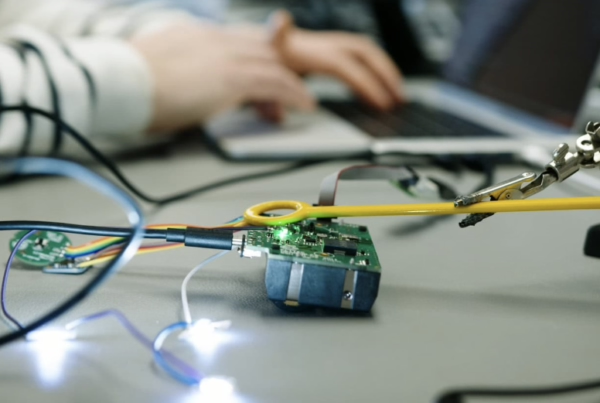
A wearable prototype typically includes the core electronics, basic firmware, and a form factor sufficient to test the primary technical hypothesis. It does not need to be comfortable, manufacturable, or aesthetically refined — it needs to answer a specific technical question reliably.
Depending on the development stage, a wearable prototype might include:
- Off-the-shelf or development-board electronics rather than custom PCBs, keeping iteration fast and cost low
- Basic enclosures or textile mounting — enough to position components correctly on the body, not enough to be worn all day
- Core firmware covering only the functions under test, often without power optimisation or edge-case handling
- Sensor and actuator selection in their most accessible form — the engineering team is still evaluating which components will survive the transition to a real product
- Wired connections or exposed components that would never appear in a finished device but allow fast debugging and modification
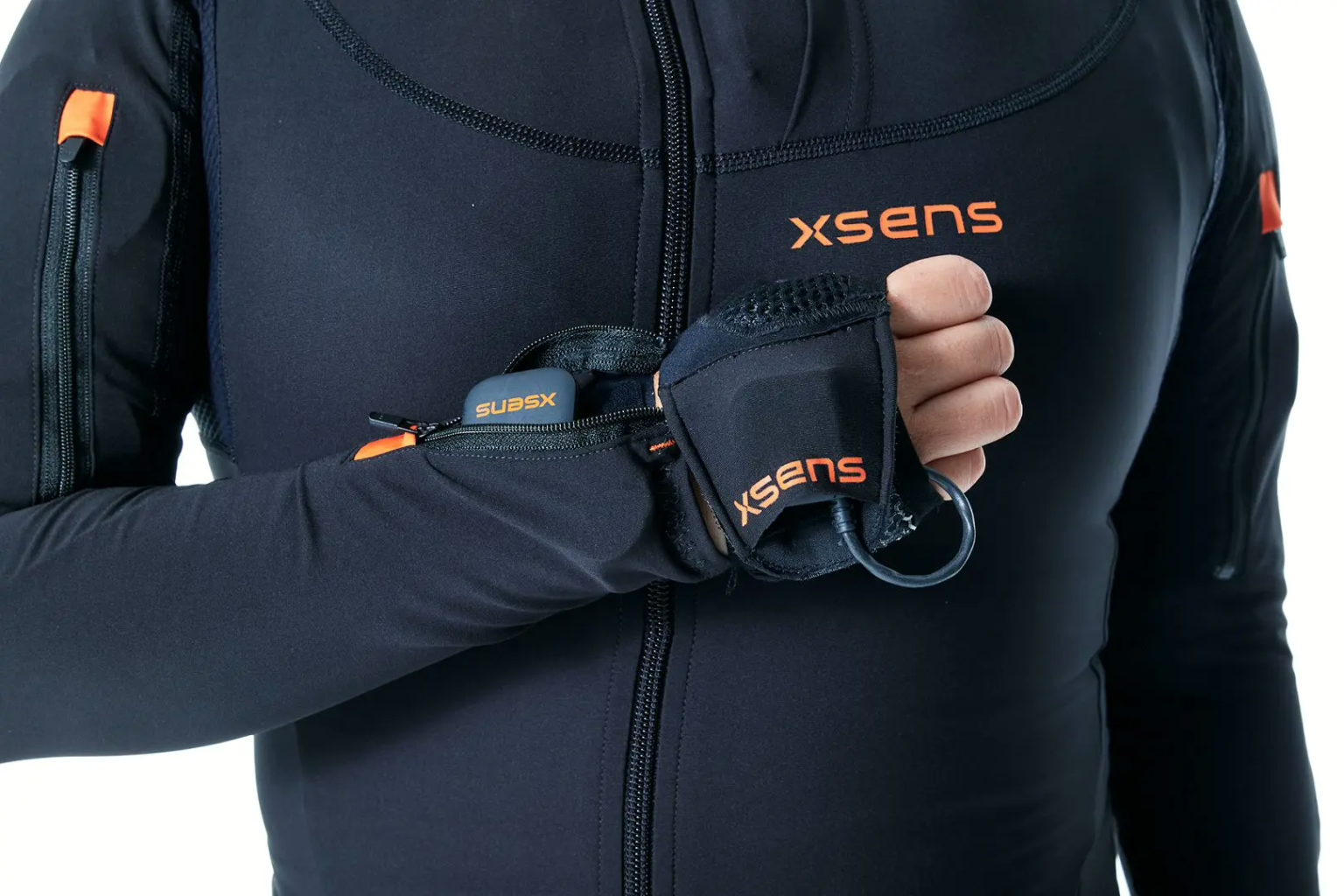
In electronics-textile wearables specifically, a prototype may also include interim integration techniques — conductive yarn hand-stitched rather than industrially applied, or a sensor taped rather than sewn into position — because the goal is to validate function, not process. The integration method is refined in later stages once the technical direction is confirmed.
What a prototype almost never includes is a polished user experience. That comes later. Expecting a prototype to feel like a finished product is a category error that leads to wasted effort.
What makes a wearable MVP different from a finished product?
A wearable MVP differs from a finished product in scope, not in quality of execution. An MVP delivers a deliberately reduced feature set — the minimum set of functions needed to generate meaningful user feedback — while a finished product delivers the complete, validated, certified experience. The MVP is a learning tool; the finished product is a market-ready solution.
In biometric wearable product development, the distinction often comes down to three dimensions:
- Features: An MVP includes only the functions central to the core value proposition. Secondary features, advanced modes, and edge-case handling are deferred until user feedback confirms they are actually needed.
- Durability and certification: An MVP is built for controlled testing conditions, not for uncontrolled daily use or regulatory submission. A finished product must pass relevant certification — CE marking, MDR compliance for medical wearables, or sector-specific standards — which adds significant documentation, testing, and design rigour.
- Manufacturability: An MVP can be produced in small quantities using semi-manual processes. A finished product requires design-for-manufacture decisions, validated supply chains, and production documentation that supports consistent quality at scale.
The practical implication is that an MVP is not a shortcut to a finished product — it is a deliberate checkpoint. The feedback gathered from an MVP informs the final design decisions that make the finished product worth building. Skipping the MVP and going straight to a finished product is how teams end up with a certified, manufactured device that users do not actually want to use.
How many prototype iterations does a wearable product typically need?
Most wearable products require between two and four prototype iterations before reaching a stage suitable for real user testing. The exact number depends on technical complexity, how novel the integration challenge is, and how clearly the requirements were defined at the outset.
A structured wearable development process typically moves through these stages:
- Proof of concept: A basic version built with off-the-shelf components to confirm the core technical principle is viable. This is the earliest prototype, often rough and not wearable in any practical sense.
- Pilot samples (2 to 10 units): Functional samples that explore features and form factor in controlled conditions. These are used internally and with a small number of trusted test participants.
- Final prototypes (5 to 30 units): Prototypes with all required features and the intended form factor, used in uncontrolled user tests — meaning real environments, real bodies, real movement.
Projects that introduce genuinely new technology — a novel actuator type, a new biosignal sensing approach, or an untested electronics-textile integration method — typically need more iterations because each unknown introduces its own cycle of build, test, and revise. Projects that build on established technical foundations, or that begin with a client who already has a working proof of concept, can move through fewer cycles.
The temptation to reduce the iteration count to save time usually backfires. Each iteration is an opportunity to retire a risk before it becomes expensive. The cost of a third prototype cycle is almost always lower than the cost of discovering a fundamental design flaw during certification or production.
Can a wearable prototype be used to secure funding?
Yes — a wearable prototype can be a highly effective tool for securing funding, provided it is built to demonstrate the right things. Investors, grant bodies, and procurement decision-makers are not evaluating whether the prototype is finished; they are evaluating whether the team understands the problem, has a credible technical approach, and can execute.
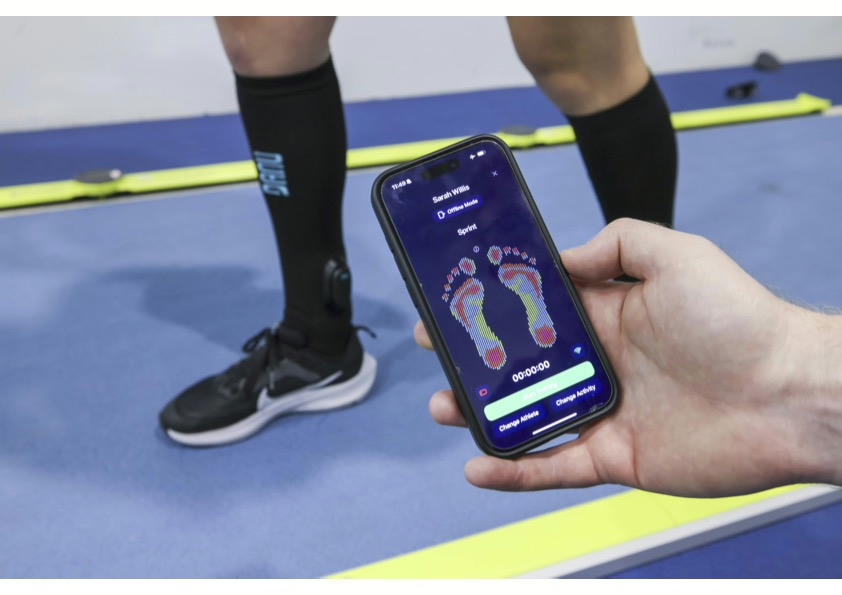
What makes a prototype compelling for funding purposes is specificity. A prototype that demonstrates a working haptic navigation signal on a real body is more persuasive than a slide deck describing the concept. A functional biosignal sensor that captures clean ECG data through a textile electrode answers the technical feasibility question before anyone has to take it on faith.
The “build for validation, not for production” approach is particularly relevant here. A set of functional demonstrators — purpose-built to show the core value proposition in a controlled setting — can be produced faster and at significantly lower cost than a production-intent prototype. The goal is to give stakeholders enough evidence to make a confident decision, not to deliver a product they can ship.
For grant-funded research programmes, early-stage prototypes often serve as the deliverable that unlocks the next funding tranche. In defence and medical procurement contexts, a working demonstrator is frequently a prerequisite for moving into a formal development contract. In both cases, the prototype is not a stepping stone to funding — it is the funding instrument itself.
What comes after the MVP in wearable product development?
After the MVP, wearable product development moves into the stages that prepare the product for real-world deployment: final prototyping, certification, first series production, and eventually scaled manufacturing. Each stage builds on the validated learnings from the MVP and progressively reduces the gap between what exists and what can be sold.
Final prototypes and certification preparation
Final prototypes incorporate all required features and the intended form factor. These are used in uncontrolled user tests — worn by real users in real environments over extended periods — and the data gathered feeds directly into the certification process. For medical wearables, this means generating the clinical and technical evidence required for MDR compliance. For industrial or defence applications, it means meeting the relevant sector standards. Certification should not be treated as a final step; the design decisions that determine whether a product can be certified need to be made much earlier in development.
First series and scaled production
A first series — typically 30 to 50 units — is the bridge between development and market. It is produced in-house or with a closely managed manufacturing partner, suitable for certification submission, early sales, and market exploration. It is not yet scaled production, but it is production-intent: the processes, documentation, and quality controls that will govern larger runs are established here.
Scaled production, which moves beyond 50 units, requires design-for-manufacture decisions, validated supply chains, and production documentation that supports consistent output without constant engineering involvement. The transition from first series to scaled production is where many wearable development projects encounter unexpected complexity — tolerances that worked at low volume become problems at scale, and manual assembly steps that were acceptable in a first series become bottlenecks.
The full end-to-end journey from proof of concept to scaled production typically takes between six months and three years, depending on technical complexity, certification requirements, and how much of the groundwork was laid in earlier stages.
How Elitac Wearables supports your prototype-to-product journey
For product managers, CTOs, and founders navigating the gap between a promising concept and a market-ready wearable, the biggest risk is not technical failure — it is building the wrong thing at the wrong stage. Elitac Wearables structures the entire development process around eliminating that risk, with a six-phase framework that moves clients from feasibility check through to scaled production without losing sight of the end user or the commercial goal.
What this means in practice:
- Prototype and MVP decisions are made with full technical context — the team advises on which stage is appropriate given your current position, your timeline, and your validation objectives
- All disciplines are in-house — hardware, firmware, textile integration, haptics, biosignal sensing, and human factors work together from day one, which means the decisions made in prototyping do not create problems in certification or production
- Demonstrators can be delivered in weeks — for teams facing investor deadlines or procurement milestones, functional wearable demonstrators can be produced rapidly and at a fraction of production-phase cost
- Certification is designed in, not bolted on — for medical and regulated wearables, MDR and CE considerations shape hardware and firmware choices from the earliest prototype stages
- The proprietary TacOS firmware platform accelerates development and reduces risk by providing a validated foundation for wearable software, rather than building from scratch
If your wearable project is at any stage — from a concept that needs a proof of concept to a prototype that needs to become a product — speak with the Elitac team about where you are and what the right next step looks like.