
Haptic feedback wearables reduce notification fatigue by delivering tactile alerts directly to the body, bypassing the visual and auditory channels that modern devices overwhelm. Instead of competing with a screen full of banners or a cacophony of notification sounds, vibration feedback reaches the wearer through touch, a sensory channel that remains largely uncluttered in most professional environments. The sections below break down exactly how this works, which sectors benefit most, and where the limitations lie.
How do haptic alerts differ from visual and audio notifications?
Haptic alerts communicate through touch rather than sight or sound, delivering a vibration pattern directly to the skin via actuators embedded in a wearable device. Unlike visual notifications that require the user to look at a screen, or audio alerts that demand a quiet enough environment to be heard, tactile feedback works regardless of lighting conditions, ambient noise, or where the user’s eyes are focused.
This distinction matters enormously in practice. A surgeon mid-procedure cannot glance at a phone. A soldier in a noisy environment may not hear a radio alert. A factory worker wearing ear protection will miss an audio warning entirely. In each case, a well-designed haptic alert cuts through because it operates on a completely different sensory pathway.
The quality of the haptic signal also varies significantly depending on the actuator technology used. The three main types are:
- ERM (Eccentric Rotating Mass) motors: The most common and cost-effective option, producing a broad, buzzing vibration. Effective for simple alerts but limited in pattern precision.
- LRA (Linear Resonant Actuators): More precise and energy-efficient, capable of producing sharper, more distinct pulses. Better suited to nuanced alert patterns.
- Piezo actuators: The most precise option, capable of high-frequency, highly localised feedback. Used in applications requiring fine-grained tactile communication, such as navigation or complex status signals.
The choice of actuator directly determines how rich and distinguishable the haptic language can be. A wearable limited to a single generic buzz can only say “something happened.” A well-engineered haptic system using LRA or piezo actuators can communicate urgency, direction, and type of alert through distinct patterns, giving the wearer far more information with far less cognitive interruption.
What causes notification fatigue in the first place?
Notification fatigue occurs when the volume, frequency, or uniformity of alerts exceeds a person’s capacity to process and act on them meaningfully. When every notification looks, sounds, or feels the same, the brain begins treating all of them as background noise, including the ones that actually matter.
The root causes are well understood in human factors research and practical wearable design:
- Channel saturation: Visual and audio channels are already heavily loaded in most professional environments. Adding more alerts to an already busy screen or soundscape compounds the problem rather than solving it.
- Lack of differentiation: When all alerts arrive with the same tone or visual style, users cannot triage them without stopping to read each one. The cognitive cost accumulates quickly.
- Interruption at the wrong moment: Alerts that arrive during high-concentration tasks force context switches that are costly to recover from. Research in cognitive load consistently shows that poorly timed interruptions degrade both the interrupted task and the response to the alert itself.
- Alert desensitisation: Repeated exposure to alerts that turn out to be low priority trains users to ignore them. This is particularly dangerous in safety-critical settings where a genuine emergency alert may be dismissed out of habit.
Wearable technology addresses these causes not by simply adding another notification channel, but by using the body itself as a more direct, lower-interruption medium. The key is that touch does not compete with vision or hearing for attention, it supplements them. A haptic pulse on the wrist or torso can signal “pay attention now” without forcing the wearer to stop what they are doing.
How do haptic wearables filter and prioritise alerts?
Haptic wearables filter and prioritise alerts through a combination of firmware-level logic, vibration pattern design, and integration with the alert source system. The device translates alert priority into distinct tactile patterns, so the wearer can identify urgency and type of notification through touch alone, without checking a screen.
The filtering mechanism typically works on two levels:
Hardware and firmware-level control
The wearable’s embedded software determines which incoming signals trigger a haptic response and what pattern that response takes. A well-designed firmware layer can assign different vibration rhythms, intensities, and durations to different alert categories. A short, sharp pulse might signal a low-priority status update, while a longer, repeating pattern signals urgent action required. Firmware-level control also manages timing to avoid alert clustering, where multiple notifications arrive simultaneously and produce an unintelligible jumble of vibrations.
System-level integration and alert logic
At the system level, the wearable connects to an alert management platform that applies priority rules before anything reaches the device. This is where the real filtering happens. Not every event in a connected environment needs to become a haptic alert. The system determines which events cross the threshold for tactile notification based on context, user role, and alert type. In a hospital setting, for example, only patient-critical events might trigger a haptic alert, while routine status updates are logged silently. In a military navigation context, such as the Mission Navigation Belt developed for the Royal Netherlands Army, haptic signals deliver directional waypoint information continuously without any competing visual or audio output.
The result is a notification architecture that respects the wearer’s attention rather than demanding it indiscriminately. Done well, this dramatically reduces the total number of interruptions while increasing the signal-to-noise ratio of every alert that does arrive.
Which industries benefit most from haptic notification management?
Industries where workers cannot safely divert their eyes or ears to check a device benefit most from haptic notification management. This includes defence and military operations, medical and clinical environments, industrial safety, and high-performance sports, all contexts where conventional notifications create risk rather than reduce it.
Breaking this down by sector:
- Defence and military: Soldiers operating in high-noise, high-stakes environments need hands-free, eyes-free communication. Haptic wearables deliver navigation cues, status signals, and warnings without requiring the user to look at a device or remove hearing protection. The Mission Navigation Belt is a direct example of this application in practice.
- Medical and clinical: Healthcare professionals monitoring multiple patients face constant alert streams from monitoring equipment. Haptic wearables can deliver patient-specific priority alerts directly to the clinician’s body, reducing the cognitive load of parsing a wall of audio alarms while keeping the clinician’s attention on the patient.
- Industrial and manufacturing: Workers in loud environments wearing PPE are effectively cut off from audio notifications. Haptic alerts integrated into workwear can signal equipment status, proximity warnings, or safety thresholds without requiring the worker to remove protective equipment or look away from machinery.
- Sports performance: Athletes and coaches use haptic feedback to receive real-time performance cues, pacing signals, or technique corrections during training without breaking focus. Wearables that deliver this kind of feedback must be robust enough for high-movement conditions, which places significant demands on both the actuator design and the textile integration.
What these sectors share is a user who is already operating at high cognitive and physical load. Haptic notifications reduce the cost of receiving information rather than adding to it.
What are the limitations of haptic feedback for notifications?
Haptic feedback for notifications has real limitations: the number of distinct patterns a wearer can reliably learn and recall is finite, body placement affects perception significantly, and poorly designed actuator systems can be uncomfortable, unreliable, or drain device battery faster than expected.
These limitations are worth understanding clearly before designing a haptic notification system:
- Pattern vocabulary is limited: Unlike visual interfaces that can display text or icons, haptic feedback is restricted to combinations of duration, rhythm, intensity, and location. Most users can reliably distinguish only a small number of distinct patterns without extensive training. Overloading the haptic vocabulary defeats the purpose.
- Body placement matters: Vibration perception varies significantly across the body. The wrist, sternum, and lower back respond differently to the same actuator output. A signal that is clearly perceptible in one location may be too subtle in another, particularly over clothing or during physical activity. This requires careful human factors testing rather than assumptions.
- Habituation is a real risk: Just as users tune out audio alerts, they can habituate to repetitive haptic patterns. Alert design needs to account for this, particularly in long-duration use cases like shift work or extended field operations.
- Power consumption: Actuators draw current, and frequent haptic alerts can significantly reduce battery life. In wearables where battery life is already constrained by form factor, this is a genuine engineering challenge. Optimising actuator firing patterns at the firmware level is essential to managing this trade-off.
- Integration complexity: Embedding actuators into a garment or wearable that must survive washing, physical stress, and extended wear is technically demanding. The electronics-textile integration challenge is one of the most common failure points in wearable development, particularly for teams without dedicated experience in this area.
None of these limitations make haptic notifications impractical. They make them an engineering problem that requires genuine expertise to solve well, rather than a feature that can be bolted onto an existing device without careful design work.
How Elitac Wearables helps you build haptic notification systems that actually work
Building a haptic wearable that meaningfully reduces notification fatigue rather than simply adding another buzz to the wearer’s day requires solving several hard problems at once: actuator selection, vibration pattern design, firmware-level alert logic, power management, and textile integration. These disciplines rarely sit under one roof, which is why so many haptic wearable projects stall or produce devices that users abandon.
Elitac Wearables brings all of these capabilities in-house. For organisations developing haptic feedback wearables for medical, defence, industrial, or sports applications, the practical advantages of this are significant:
- Actuator selection guidance across ERM, LRA, and piezo technologies, matched to your specific application, body location, and use case requirements
- Vibration pattern design and firmware-level timing optimisation, including the proprietary TacOS operating system built specifically for wearable haptic applications
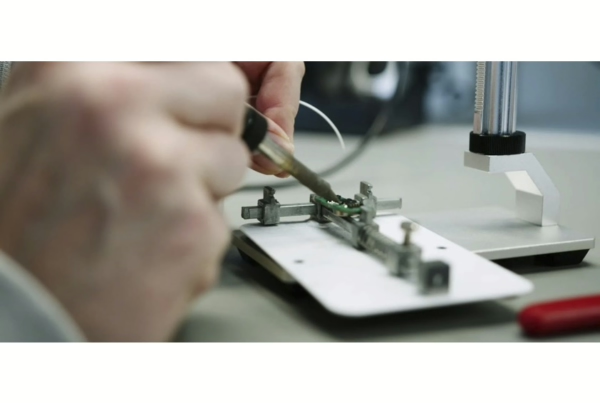
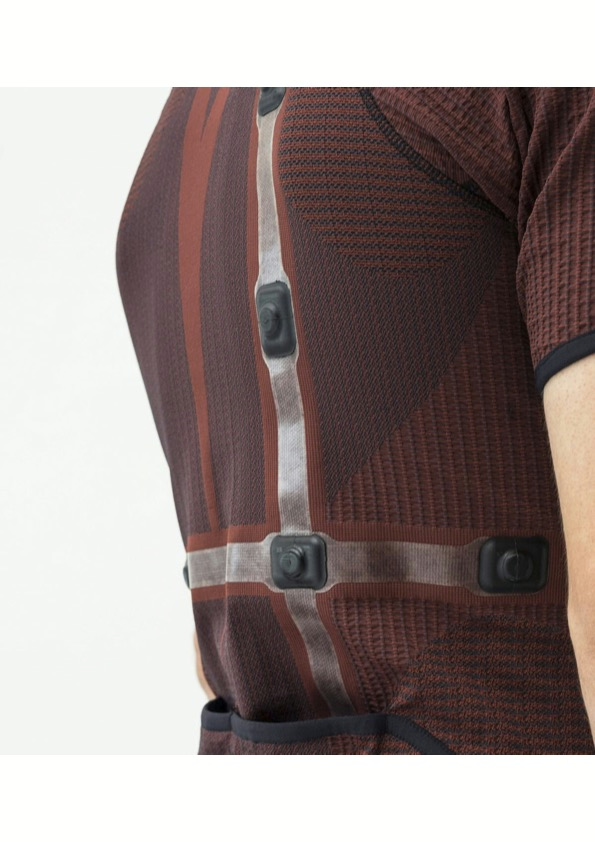
- Electronics-textile integration expertise developed across more than a decade of body-worn device projects, including washable and high-movement contexts
- Human factors considerations built into every development stage, so the haptic language your device uses is one that real users can learn, trust, and rely on
- Battery performance optimisation to ensure actuator activity does not compromise device longevity
- End-to-end development from proof of concept through to certified, production-ready product, with no handoffs between vendors
If you are evaluating whether haptic feedback belongs in your next wearable product, or if you are already in development and running into the limitations described above, speak with the Elitac Wearables team. The conversation starts with your application, not a product catalogue.
Related Articles
- How do wearables monitor soldier health in the field?
- How do developers integrate haptic feedback into wearable devices?
- What should a Head of Product demand from a wearable development partner at each project milestone?
- What should a CTO look for when evaluating a wearable development partner?
- What is the difference between a prototype and an MVP in wearable development?