For most organisations, outsourcing e-textile prototyping makes more sense than building the capability in-house, unless your core business is wearable technology itself. Integrating electronics into textiles is a distinct engineering discipline that demands specialist skills, dedicated equipment, and hard-won experience that takes years to accumulate. The sections below break down exactly what that means in practice: what makes this discipline different, what it genuinely requires, and how to make the right call for your organisation.
What makes prototyping electronics in textiles technically different from standard PCB development?
Prototyping electronics integrated into textiles is fundamentally different from standard PCB development because the substrate is alive: it stretches, bends, washes, and moves with a human body. A rigid circuit board sits in a fixed enclosure. A textile-integrated electronic system must maintain electrical integrity across thousands of movement cycles, survive laundering, conform to body contours, and still function when the wearer sweats. That combination of constraints does not exist in conventional electronics work.
The differences run deeper than materials. Consider signal quality: a biosensor mounted on a PCB in a lab produces clean data. The same sensor sewn into a garment worn during physical activity picks up motion artefacts, electrical noise generated by movement and skin contact variation, that can render the signal clinically useless. Solving this requires expertise in dry electrode selection, garment construction, sensor placement, and firmware-level signal processing simultaneously. No single discipline owns the problem.
Power management is another area where textile integration creates unique constraints. You cannot simply add a larger battery when the form factor is a vest, sock, or belt. Every milliamp-hour matters, which means firmware, hardware component selection, communication protocols, and data architecture all need to be co-optimised from the start. Teams that approach this as a standard embedded electronics project consistently discover these constraints late, at exactly the point where changes are most expensive.
Then there is the integration technique itself. Conductive yarns, printed electronics, snap connectors, and overmoulded attachments each have different implications for washability, flexibility, durability, and manufacturing complexity. Choosing the wrong technique at the prototype stage does not just affect the prototype, it can invalidate the entire development path if the chosen method cannot scale or survive real-world use conditions.
What capabilities does in-house e-textile prototyping actually require?
Building a genuine in-house e-textile prototyping capability requires at minimum five distinct areas of expertise: electronics hardware design, embedded firmware, textile and garment engineering, human factors, and knowledge of the relevant certification landscape. Most organisations have one or two of these. Very few have all five. The gap between having some of these capabilities and having all of them integrated is where most smart textile development projects stall.
On the hardware side, you need engineers who understand both PCB design and the constraints imposed by flexible, body-worn form factors: component selection for low-power operation, custom enclosure design that survives flexion, and connector choices that hold under movement. Standard electronics prototyping skills transfer partially, but the wearable-specific constraints require additional depth.
Textile expertise is non-negotiable and is consistently underestimated by electronics teams. Garment construction, fabric selection for biocompatibility and durability, integration technique selection, and washability testing are all specialist disciplines. A firmware engineer cannot evaluate whether a conductive yarn will maintain its resistance after fifty wash cycles. That requires a textile engineer with wearable-specific experience.
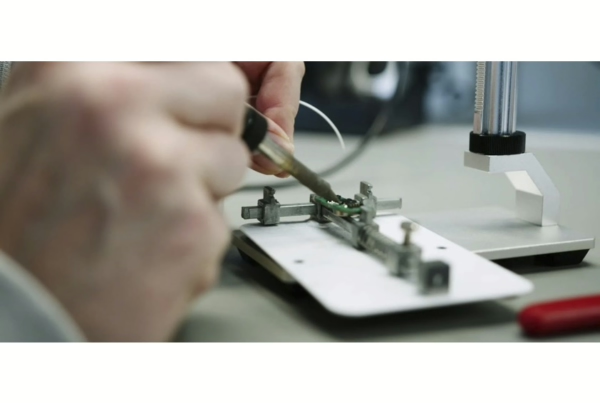
Beyond the technical roles, in-house e-textile prototyping requires physical infrastructure: 3D printers for enclosure iteration, laser cutters for textile work, soldering and electronics assembly capability, and software testing environments that can simulate real-world usage patterns. Assembling and maintaining this equipment base is a significant ongoing investment, one that only makes financial sense if wearable development is central to your business model rather than a single project.
When does outsourcing e-textile prototyping make more sense than building in-house?
Outsourcing e-textile prototyping makes more sense than building in-house when wearable technology is not your core business, when you need to validate a concept before committing to major infrastructure investment, or when your project requires expertise across multiple disciplines that would take years to hire and develop internally. For the vast majority of organisations developing a smart textile product, outsourcing is the lower-risk and more cost-effective path.
The clearest case for outsourcing is a first-time wearable project. If your organisation has never built a body-worn electronic device before, the learning curve is steep and the failure modes are non-obvious. Industry experience consistently shows that up to 70% of wearable prototypes never reach production, and the primary cause is not technical impossibility but assumptions that go untested until too late. A specialist development partner has already encountered and solved the failure modes you have not yet imagined.
Budget timelines also favour outsourcing for most organisations. Building an in-house team with genuine cross-disciplinary e-textile capability requires hiring hardware engineers, firmware developers, textile specialists, and human factors experts, then equipping them with appropriate tooling. That investment runs into hundreds of thousands of euros before a single prototype is built. Outsourcing converts that fixed cost into a project-based variable cost, with expertise available immediately rather than after an eighteen-month hiring process.
Outsourcing also makes sense when speed matters. A specialist partner with existing hardware building blocks, established integration techniques, and a functioning lab can deliver functional demonstrators in weeks rather than months. For organisations facing investor deadlines, regulatory submission timelines, or competitive pressure, that acceleration is often the deciding factor.
What are the risks of outsourcing electronics-in-textile prototyping to a generalist partner?
The primary risk of outsourcing smart textile development to a generalist electronics or product design firm is that the wearable-specific constraints are not understood until they surface as expensive problems late in development. A generalist partner may be highly competent at standard electronics work but lack the textile expertise, body-worn sensing experience, and certification knowledge that e-textile integration specifically demands. The result is a prototype that works on a bench but fails in real-world use.
Fragmented supply chains are a common symptom. When electronics work is handled by one team and textile construction by another, with no single partner owning the integration, critical decisions fall through the gaps. Who decides how the PCB enclosure attaches to the garment? Who owns the problem when conductive yarn connections degrade after washing? Who understands both the electrical requirements and the garment construction constraints well enough to make the right call? In a fragmented arrangement, nobody does.
Certification is another area where generalist partners frequently underdeliver. Medical wearables require MDR compliance. Devices for hazardous environments need ATEX certification. Military applications carry their own standards. These are not documentation tasks that can be added at the end of development, they shape hardware choices, material selection, and testing protocols from the earliest prototype stage. A partner without this experience will not flag the implications early enough, and late-stage certification failures are among the most expensive problems in wearable development.
Finally, there is the risk of misaligned expectations around what a prototype actually needs to demonstrate. A generalist partner optimising for a functional proof of concept may deliver something that works technically but cannot be worn comfortably, cannot survive a wash cycle, or cannot scale to production without a complete redesign. The cost of discovering this late, after tooling decisions have been made and development budgets spent, is substantial.
How do you evaluate a wearable development partner for e-textile prototyping?
Evaluating a wearable development partner for e-textile prototyping comes down to five criteria: demonstrated cross-disciplinary capability, relevant sector experience, in-house infrastructure, a structured development methodology, and transparency about what they do not know. A partner who excels on all five is rare, but each criterion is genuinely important, and weakness in any one of them creates predictable project risk.
Cross-disciplinary capability and relevant experience
Ask directly whether hardware, firmware, textile, and human factors expertise sit under one roof or are assembled through subcontractors. Subcontracting is not automatically a problem, but fragmented accountability is. You want a partner where a single team owns the integration challenge, not one that hands textile questions to a separate supplier with no shared context.
Sector experience matters because the constraints in medical e-textile development are different from those in defence, sports, or industrial safety. A partner with relevant reference projects, ideally in your sector, has already encountered the failure modes specific to your use case. Ask for concrete examples: not just that they have done medical wearables, but what specific certification challenges they navigated, what integration techniques they used, and what problems they solved mid-development.
Infrastructure, methodology, and intellectual honesty
In-house lab infrastructure is a meaningful signal. A partner with their own 3D printers, laser cutters, and electronics assembly capability can iterate faster and at lower cost than one that outsources every physical step. Ask what their typical timeline is from brief to first functional prototype, and what enables that speed.
A structured development methodology matters as much as technical capability. The best partners de-risk projects by validating assumptions early and cheaply, building for validation before building for production. Ask how they approach the transition from proof of concept to pilot samples, and how they handle situations where the initial concept proves technically unviable.
Finally, intellectual honesty is underrated. A credible partner will tell you clearly what they have not done before, where the technical risks in your project sit, and what the realistic cost and timeline range looks like. Overconfidence at the proposal stage is a reliable predictor of problems during development.
How Elitac Wearables helps with electronics integrated into textiles
Elitac Wearables is a specialist end-to-end wearable development partner based in the Netherlands, with over a decade of experience integrating electronics into textiles across medical, defence, sports, and industrial applications. For organisations evaluating whether to build in-house or outsource their smart textile development, Elitac offers a direct alternative to assembling a multidisciplinary team from scratch.
- Full cross-disciplinary capability in-house: hardware, firmware, textile engineering, human factors, and algorithm development under one roof, with no handoffs between disconnected suppliers
- Proven integration techniques: conductive yarns, printed electronics, modular attachment, and overmoulding, selected based on your specific washability, flexibility, and durability requirements
- Rapid validation approach: functional demonstrators delivered in weeks using existing building blocks and the proprietary TacOS firmware platform, reducing cost and time at the highest-risk stage of development
- Sector-specific certification experience: MDR for medical wearables, CE marking, ATEX for hazardous environments, and military standards, integrated into the development process from day one, not added at the end
- Reference projects across sectors: including the Mission Navigation Belt for the Royal Netherlands Army, the BalanceBelt medical wearable, and the Flight Sense System biosensor platform
If you are weighing the in-house versus outsource decision for an e-textile project, the most useful first step is a direct conversation about your specific constraints. Get in touch with the Elitac team to discuss your project and find out what a structured development partnership looks like in practice.
Related Articles
- What is the difference between an exoskeleton and a smart vest?
- How does wearable technology reduce casualties in combat?
- How do you manage risk across a wearable product development program?
- How do you reduce time-to-market in wearable product development?
- What are the regulatory risks that can stall a wearable product launch, and how do you mitigate them?