
Managing risk across a wearable product development program requires identifying and addressing risks early, at the stage where they are cheapest to resolve. The most effective approach combines structured phase-gating, early regulatory planning, and keeping all technical disciplines under one roof so that hardware, firmware, textile, and certification decisions are made in coordination rather than in isolation. The sections below break down the most common risk questions that development teams and decision-makers face.
What are the biggest risk categories in wearable development?
The biggest risk categories in wearable product development are technical integration risk, regulatory and certification risk, validation timing risk, and supply chain fragmentation risk. Each of these can independently derail a program, but they frequently compound one another when development teams are not structured to manage them in parallel.
Technical integration risk is particularly acute in wearables because the product sits at the intersection of multiple disciplines that rarely converge in a single team. Electronics that perform reliably on a bench behave differently when embedded in a flexible textile on a moving body. Sensors that pass lab tests produce motion artifacts in real-world use. Haptic actuators that feel intuitive in isolation become confusing when combined with other feedback modalities. Each of these is a known failure point, and each requires specialist knowledge to anticipate.
Validation timing risk is arguably the most commercially damaging. Industry experience consistently shows that a large proportion of wearable prototypes never reach production, and the primary cause is not technical infeasibility but validating user interaction, comfort, and perceived value too late in the cycle. By the time teams discover a fundamental usability problem, they have already committed to tooling, enclosure design, and component selection that is expensive to reverse.
Regulatory risk is often underestimated at the concept stage. For medical wearables subject to MDR, or products destined for hazardous environments requiring ATEX certification, the documentation burden, testing requirements, and design constraints are substantial. Teams that treat certification as a final step rather than a design input routinely face costly redesigns.
Supply chain fragmentation risk emerges when hardware, firmware, and textile work is distributed across separate vendors with no single party accountable for integration. Each handoff introduces ambiguity, and problems that fall between disciplines often go unresolved until late in development, when they are hardest to fix.
How does risk change at each stage of the development cycle?
Risk in wearable development does not stay constant. It shifts in character at each phase: early stages carry high uncertainty risk, middle stages carry integration and validation risk, and late stages carry regulatory, production, and cost-overrun risk. Understanding where you are in the cycle determines which risks deserve the most attention.
Early stages: uncertainty and assumption risk
In the feasibility and proof-of-concept phases, the dominant risk is building on unvalidated assumptions. Teams may assume a sensing modality will work on a specific body location, that a particular actuator will produce the right haptic sensation, or that users will accept a certain form factor. These assumptions cost relatively little to test at this stage but can cost significantly more if they survive unchallenged into later phases. The goal of early-stage work is to surface and eliminate the riskiest assumptions as quickly and cheaply as possible.
Mid-stage: integration and user validation risk
Once pilot samples and functional prototypes are in play, risk shifts toward integration failures and user feedback. This is the stage where electronics-textile combinations are stress-tested, where firmware must handle real-world usage patterns rather than controlled conditions, and where the first meaningful user feedback arrives. Discovering a comfort problem or a signal quality issue at this stage is manageable. Discovering it at the final prototype stage, when form factor decisions are locked, is expensive. Controlled user testing during the pilot sample phase is one of the highest-leverage risk reduction activities available to a development team.
Late stages: regulatory, production, and cost risk
Final prototypes and first-series production introduce a different class of risk. Regulatory submissions require complete technical documentation, and any design change triggered by a certification finding restarts parts of that process. Production tooling, which can represent a significant capital commitment, locks in design decisions that were previously flexible. At this stage, the cost of a mistake is measured not just in engineering time but in tooling write-offs, delayed market entry, and regulatory re-submissions.
What’s the difference between risk mitigation and risk transfer in wearable projects?
Risk mitigation in wearable development means reducing the probability or impact of a risk through design decisions, testing, and process discipline. Risk transfer means shifting the consequence of a risk to another party, typically through contracts, insurance, or supplier agreements. Both have a role, but mitigation is almost always more valuable in complex custom wearable programs.
Risk transfer has clear limits in wearable development. A contract that holds a supplier liable for a late delivery does not recover the market window you missed. A warranty clause does not undo a failed clinical validation. For genuinely novel products, there is often no counterparty willing to absorb the technical risk anyway, because the unknowns are shared by everyone in the room.
Mitigation, by contrast, directly reduces the likelihood that a problem occurs. Building demonstrators before committing to production tooling is mitigation. Running user tests in controlled conditions before uncontrolled field trials is mitigation. Designing for certification requirements from the first hardware revision rather than retrofitting them is mitigation. In each case, the cost of the mitigation activity is a fraction of the cost of the failure it prevents.
The practical implication for decision-makers is this: invest heavily in mitigation during the early and middle phases of development, when changes are inexpensive. Use risk transfer mechanisms to manage residual risks at the production and commercialisation stage, where the risk profile is more predictable and more insurable.
How do you de-risk hardware and textile integration early?
De-risking hardware and textile integration early means making the integration the first thing you test, not the last. The most effective approach is to build functional demonstrators specifically designed to stress-test the integration points, rather than waiting until a full prototype is available. This allows teams to identify failure modes in the electronics-textile interface before those decisions are locked into a production-intent design.
Several specific practices reduce integration risk at the earliest stages:
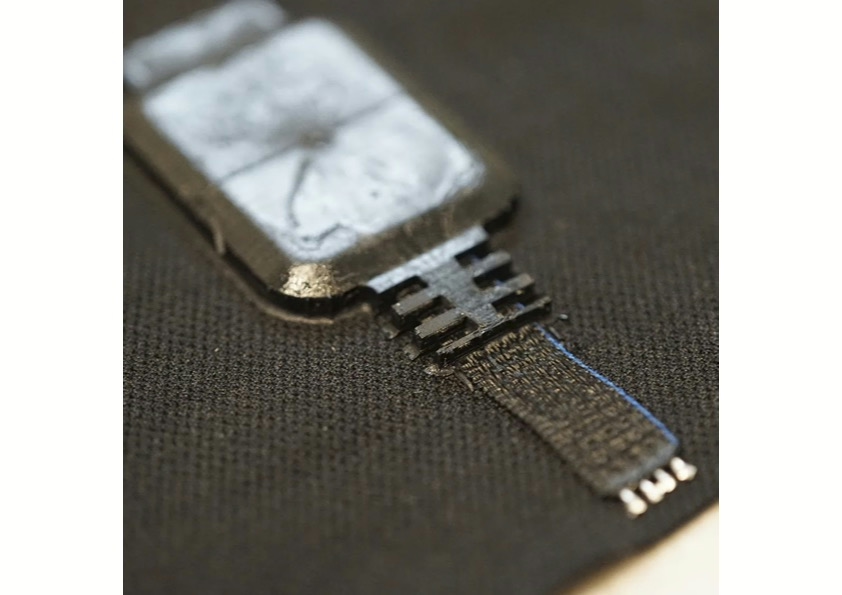
- Select integration technique before selecting components. The choice between conductive yarns, printed electronics, and modular attachment methods has significant implications for washability, flexibility, and repairability. This decision should precede detailed hardware design, not follow it.
- Test on the body, not on the bench. Sensors, connectors, and actuators behave differently when worn. Motion artifacts in biosignal sensing, connector fatigue from repeated flexion, and actuator performance variation with skin contact pressure are all body-worn phenomena that bench testing does not reveal.
- Prototype for failure, not for demonstration. Early demonstrators should be designed to find the edges of acceptable performance, not to look impressive. A demonstrator that reveals a critical failure mode early is more valuable than one that performs well under ideal conditions.
- Involve textile and electronics expertise simultaneously. Integration problems almost always arise when these disciplines work sequentially rather than in parallel. A textile engineer and an electronics engineer who design together will anticipate conflicts that neither would catch working alone.
- Plan for washability and durability from the start. In wearables, these are not finishing considerations. They constrain material selection, connector placement, and enclosure design in ways that must be resolved before the form factor is finalised.
The “build for validation, not for production” principle applies directly here. A functional demonstrator built to stress-test integration decisions costs a fraction of a production-intent prototype but provides the information needed to make production-intent decisions confidently.
When should regulatory and certification risk enter the development roadmap?
Regulatory and certification risk should enter the development roadmap at the feasibility stage, before any hardware design decisions are made. For medical wearables subject to MDR, or products requiring ATEX or military certification, the regulatory requirements directly constrain component selection, enclosure design, documentation processes, and testing protocols. Treating these as a late-stage concern is one of the most reliably expensive mistakes in wearable product development.
The practical reason is straightforward: certification requirements are design inputs, not design outputs. MDR compliance for a Class II medical wearable, for example, requires a clinical evaluation, a risk management file, and technical documentation that must trace back through the entire development history. If the development history does not reflect regulatory thinking from the start, the documentation cannot be constructed retrospectively without gaps that regulators will identify.
For teams in the early stages of a medical or safety wearable program, the minimum viable regulatory activity at the feasibility stage includes:
- Classifying the intended device under the applicable regulatory framework (MDR, ATEX, CE marking)
- Identifying which standards apply to the device category and intended use
- Flagging any design choices at the feasibility stage that would create certification problems later
- Establishing a risk management process that runs in parallel with development from the outset
Certification costs increase substantially the later they are introduced. A design change required by a regulatory finding at the final prototype stage triggers not just engineering rework but retesting, documentation revision, and potential delays to market entry. The same change identified at the proof-of-concept stage costs a fraction of that. Early certification planning is not a bureaucratic overhead, it is a direct risk reduction investment with a measurable return.
Who is responsible for risk management in a wearable development program?
In a wearable development program, risk management is the shared responsibility of the development team lead and the client’s product decision-maker, with specific technical risks owned by the discipline specialists accountable for each domain. No single role can manage all risk categories in isolation because the risks span hardware, firmware, textile, regulatory, and commercial dimensions simultaneously.
The most common failure mode is treating risk management as a project management function rather than a technical and strategic one. A project manager can track risk registers and flag schedule slippage. They cannot identify that a particular actuator selection will create EMC compliance problems, or that a textile lamination technique will fail washability testing at a specific temperature. Those risks require the engineers who understand the domain to own them explicitly.
From the client’s side, the decision-maker, whether a CTO, Head of Product, or R&D director, carries responsibility for the commercial and strategic risks: the decision to proceed to the next phase, the timing of regulatory investment, and the go or no-go on tooling commitment. These decisions require clear information from the development team about technical status, and a development partner who provides that information honestly rather than optimistically.
In practice, effective risk management in wearable development depends on one structural condition: all disciplines must be in communication throughout the program, not just at handoff points. When hardware, firmware, textile, and certification expertise operate in silos, risks that live at the boundaries between disciplines go unowned. When they operate as a single integrated team, those boundary risks surface early and get resolved before they become program-threatening.
How Elitac Wearables helps manage risk across a development program
Elitac Wearables is structured specifically to address the risk categories that derail most wearable programs. For CTOs, product leads, and R&D directors managing complex custom wearable development, the practical advantages are concrete:
- All disciplines in-house: Hardware, firmware, textile integration, biosignal sensing, haptics, and certification guidance operate as a single team. Risks that fall between disciplines are owned, not passed between vendors.
- Phased development with clear go/no-go points: The six-phase framework, from feasibility check through to scaled production, structures risk reduction into the program from the outset. Each phase has defined outputs that must be validated before committing budget to the next.
- Build for validation, not production: Functional demonstrators and pilot samples are designed to surface integration and usability failures before tooling commitments are made. This directly addresses the validation timing risk that causes the majority of wearable programs to stall.
- Regulatory planning from phase one: For medical and safety wearables, certification requirements are treated as design inputs, not final-stage activities. The team’s experience with MDR, CE marking, ATEX, and military certification means these constraints are identified and managed before they become costly surprises.
- Proprietary TacOS firmware platform: The in-house operating system, purpose-built for wearables, reduces firmware risk by providing a tested foundation rather than building from scratch on every project.
- Transparent cost and time estimates: Actual hours will not exceed the estimate by more than 10% without prior consultation, giving decision-makers the predictability they need to manage program budgets and board commitments.
If your wearable program is carrying risks you are not sure how to resolve, whether that is a prototype that is not reliable enough for real-world use, an integration challenge between electronics and textiles, or a certification path that has not been mapped yet, contact Elitac Wearables to discuss where your program stands and what the right next step looks like.