
Haptic feedback wearables deliver tangible benefits across safety, rehabilitation, navigation, and performance — by replacing or supplementing visual and audio signals with direct tactile stimulation on the body. The core advantage is that touch-based feedback reaches the user without demanding conscious attention, making it particularly powerful in high-load, high-stakes environments. This article unpacks how haptic wearables work, where they deliver the most value, and when custom development is the right investment.
How does haptic feedback work in wearable devices?
Haptic feedback in wearable devices works by converting electrical signals into physical vibrations or pressure sensations that the wearer can feel directly on the skin. A microcontroller sends timed signals to one or more actuators embedded in the garment or device, which then produce precisely controlled tactile output at specific body locations.
The three main actuator types used in wearable haptics each have distinct characteristics:
- ERM (Eccentric Rotating Mass) motors are the most common and cost-effective option. They produce a buzzing sensation by spinning an off-centre weight. Response time is relatively slow, which limits pattern resolution, but they are robust and well-understood for straightforward alert applications.
- LRA (Linear Resonant Actuators) vibrate along a single axis, producing a cleaner, more localised sensation. They respond faster than ERMs and are better suited to nuanced patterns and directional cues.
- Piezo actuators offer the highest precision and fastest response, with very low power consumption. They are the preferred choice for medical-grade applications and situations where fine-grained tactile communication is essential.
Beyond the actuator itself, the quality of a haptic wearable depends heavily on firmware-level timing and pattern design. A well-engineered haptic system does not simply switch vibration on and off — it controls intensity, duration, rhythm, and location across multiple actuators simultaneously to communicate specific meanings. This is where the real engineering complexity lies, and why actuator selection alone does not determine the effectiveness of a haptic wearable.
What are the main benefits of haptic feedback wearables?
The main benefits of haptic feedback wearables are hands-free, eyes-free communication, faster response times in high-cognitive-load situations, and the ability to deliver private, discreet signals that do not disrupt the surrounding environment. These advantages make haptic wearables particularly effective wherever visual or audio alerts are impractical or insufficient.
Breaking these benefits down in practical terms:
- Attention without distraction: Tactile signals are processed rapidly and do not require the user to look away from a task or listen through ambient noise. In environments where focus is critical, this is a meaningful safety and performance advantage.
- Directional and spatial communication: Unlike a buzzing phone or an alarm, haptic patterns placed at multiple body locations can convey direction, urgency, or sequencing — information that audio and visual alerts struggle to encode efficiently.
- Accessibility: For users with hearing impairments or visual limitations, haptic feedback opens up channels of communication that were previously unavailable through standard alert systems.
- Discreet signalling: In clinical, military, or social settings where audible alerts are inappropriate, haptic wearables deliver information silently and privately to the individual wearer.
- Biofeedback and rehabilitation: Haptic wearables can close the sensory loop in therapeutic contexts — providing real-time feedback on posture, balance, or movement that supports motor learning and recovery.
The cumulative effect is a communication channel that works with the body rather than demanding attention away from the task at hand. For organisations developing wearables in demanding real-world conditions, that distinction is not marginal — it is often the entire design rationale.
Which industries benefit most from haptic wearables?
The industries that benefit most from haptic feedback wearables are medical and rehabilitation, defence and military, sports performance, and industrial safety. These sectors share a common characteristic: users operate in conditions where conventional alert systems are unreliable, distracting, or simply unavailable.
Medical and rehabilitation
In clinical and therapeutic contexts, haptic wearables support balance rehabilitation, gait correction, and motor retraining. Patients with vestibular disorders, neurological conditions, or post-surgical limitations can receive continuous, real-time tactile guidance that reinforces correct movement patterns. The BalanceBelt, developed by Elitac Wearables, is a direct example — a haptic belt that helps users with balance disorders maintain orientation through vibrotactile cues.
Defence and military
Soldiers operating in high-noise, high-stress environments cannot reliably receive audio or visual navigation cues. Haptic navigation systems — such as the Mission Navigation Belt developed for the Royal Netherlands Army — deliver directional information directly to the body, freeing the soldier’s eyes and ears for situational awareness. The result is faster, more reliable navigation without adding cognitive load.
Sports performance
Athletes and coaches use haptic wearables to deliver real-time technique feedback during training, where verbal instruction is impractical and visual monitoring requires stopping the activity. Haptic cues tied to movement sensors can signal form deviations, pacing targets, or effort thresholds in the moment they occur.
Industrial and professional environments
In loud manufacturing environments or roles where workers wear hearing protection, haptic alerts provide a reliable fallback channel for safety-critical signals. The technology is also being explored in proximity warning systems and ergonomic monitoring, where the goal is to prevent injury before it happens rather than respond after the fact.
How do haptic wearables compare to visual and audio alerts?
Haptic wearables outperform visual and audio alerts in environments where the user’s eyes and ears are already occupied, where noise levels make audio unreliable, or where discretion is required. The key distinction is that haptic feedback is delivered directly to the body and does not compete with the user’s primary sensory channels.
Visual alerts require the user to look at a screen or indicator — which means redirecting attention away from the task. In fast-moving situations, that redirection introduces both delay and risk. Audio alerts depend on the ambient sound environment being manageable, and they are inherently public — everyone nearby receives the signal, not just the intended recipient.
Haptic feedback sidesteps both constraints. It is private, immediate, and does not require the user to shift attention to a secondary device. Research in human factors consistently shows that multimodal feedback — combining haptic with visual or audio — produces faster and more accurate responses than any single modality alone. The practical implication for wearable developers is that haptics rarely replace other alert types entirely; it complements them, filling the gaps where visual and audio channels fall short.
There are contexts where audio or visual alerts remain the better choice. Simple, low-frequency notifications in a quiet office environment do not justify the added complexity of haptic integration. The case for haptic feedback strengthens as the environment becomes more demanding, the user more task-saturated, and the stakes of a missed alert higher.
What are the limitations of current haptic feedback wearables?
The main limitations of current haptic feedback wearables are actuator bulk and comfort, battery life constraints, the learning curve required for users to interpret complex haptic patterns, and the technical difficulty of maintaining consistent performance on a moving, flexible body. These are genuine engineering challenges, not minor inconveniences.
- Comfort and form factor: Actuators add thickness, rigidity, and weight to a garment. Achieving meaningful haptic output while maintaining wearability — especially for extended use or high-movement applications — requires careful mechanical design and textile integration.
- Battery performance: Haptic actuators, particularly when firing in complex patterns across multiple locations, draw meaningful current. Power management is a system-level challenge that affects both hardware design and firmware architecture. Poorly optimised systems drain batteries far faster than necessary, which shortens usage sessions and frustrates end users.
- Signal intelligibility: Haptic patterns must be learned. Unlike a red warning light, a vibration pattern carries no inherent meaning — users need training to associate specific patterns with specific messages. The more complex the communication system, the greater the cognitive investment required from the wearer.
- Motion artefacts and placement consistency: On a moving body, actuator position relative to the skin shifts. Vibration intensity and perceived location can vary depending on how tightly a garment fits, the user’s body type, and their activity level. Designing for consistent perception across a realistic user population is harder than it appears in a lab setting.
- Integration complexity: Embedding actuators, wiring, and control electronics into a garment that must be washable, flexible, and durable requires expertise that sits at the intersection of electronics and textile engineering — a combination that most development teams do not have in-house.
These limitations are solvable, but solving them requires disciplined engineering across hardware, firmware, and textile design simultaneously. Teams that treat haptics as a component add-on rather than a system-level design challenge tend to encounter these problems late in development, when they are most expensive to fix.
When should an organisation invest in custom haptic wearable development?
An organisation should invest in custom haptic wearable development when off-the-shelf components cannot meet the specific performance, form factor, or regulatory requirements of the application — and when the cost of a failed or delayed product exceeds the investment in getting it right from the start. Custom development is not the default choice; it is the right choice when the problem is genuinely complex.
Specific triggers that indicate custom development is warranted:
- The wearable must meet medical device regulations (MDR Class I or II), military certification, or sector-specific compliance standards that generic products do not address
- The application requires haptic patterns, actuator placement, or body-worn form factors that do not exist in the commercial market
- The product must integrate haptic feedback with biosensors, movement tracking, or other data streams in a single, unified device
- The end user population has specific needs — clinical patients, soldiers, athletes — that demand validated performance rather than assumed adequacy
- The organisation has a prototype that works in controlled conditions but fails in real-world use, and the gap cannot be closed by iterating on existing components
Organisations that are genuinely stuck — where in-house expertise has reached its limit, where a supplier handoff has left no one accountable for the whole system, or where a prototype has stalled at proof-of-concept for longer than planned — are exactly the clients for whom specialist development partnership delivers the most value.
How Elitac Wearables helps with haptic feedback wearable development
Elitac Wearables is a Netherlands-based specialist in haptic feedback wearable development, working with B2B clients across medical, defence, sports, and industrial sectors from concept through to a certified, production-ready product. For organisations facing the challenges described above, the value of working with a team that holds every relevant discipline in-house — hardware, firmware, textile integration, and human factors — is the elimination of the coordination gaps where most wearable projects stall.
In practice, this means:
- Actuator selection grounded in application context: ERM, LRA, or piezo — the choice is made based on the specific body location, usage pattern, power budget, and required pattern resolution, not on what is easiest to source
- Firmware-level haptic pattern design using the proprietary TacOS operating system, purpose-built for wearable constraints
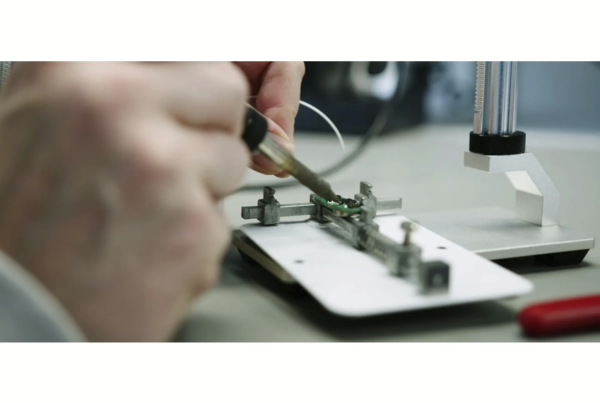
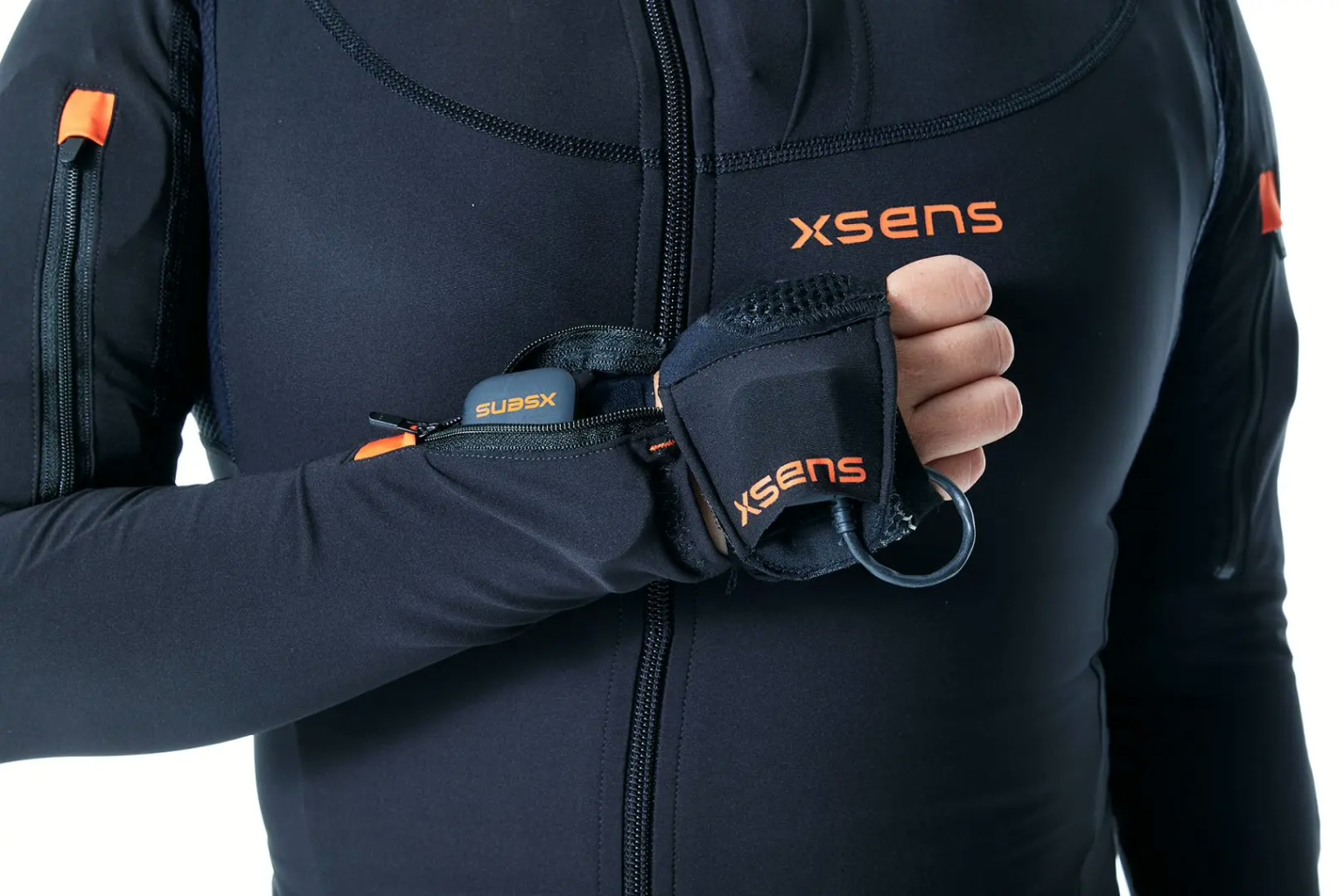
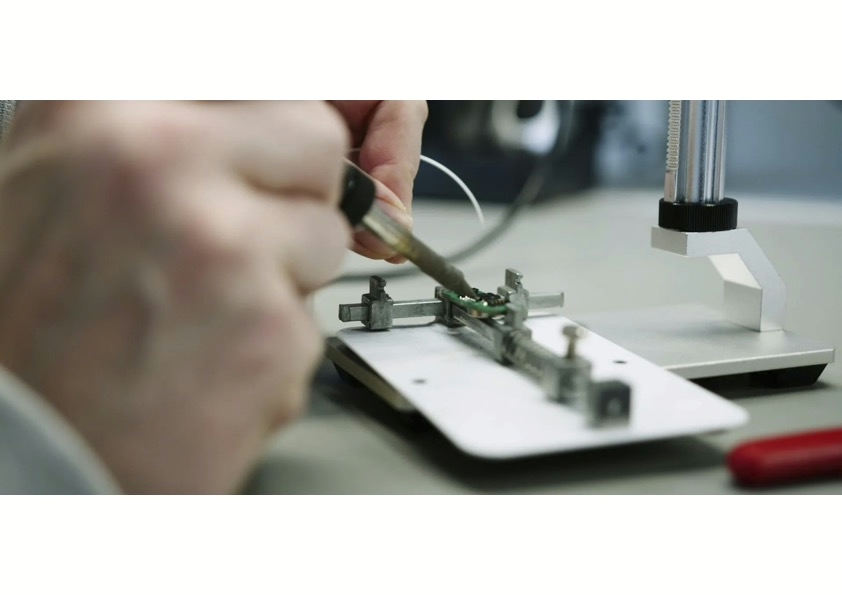
- Electronics-textile integration with over a decade of experience across washable, flexible, and body-worn contexts
- Certification guidance built into the development process from the beginning, not retrofitted at the end
- A six-phase development framework that moves clients from feasibility check to market-ready product without handoffs between vendors
If your organisation has a haptic wearable challenge that standard solutions have not been able to solve, the right next step is a direct conversation with a team that has solved it before. Get in touch with Elitac Wearables to discuss your project.
Related Articles
- What is the future of military wearable technology?
- How do military wearables communicate with command systems?
- What sensors are used in haptic feedback wearable devices?
- How do enterprise wearable products differ in development from consumer-facing devices?
- Can a startup successfully compete in wearable product development?