

Wearable product development is significantly harder than conventional electronics development because it demands the simultaneous resolution of competing constraints: a device must be electronically functional, physically comfortable, mechanically durable, regulatory-compliant, and manufacturable at scale. Unlike a circuit board that sits in a box, a wearable sits on a human body — and that changes everything. The sections below unpack the specific challenges that trip up development teams at every stage, from initial hardware design through to production.
Why is wearable product development harder than other electronics?
Wearable product development is harder than standard electronics development because the human body introduces constraints that a static enclosure never does. The device must flex, breathe, wash, and conform to movement while maintaining reliable electrical performance. Every design decision involves a trade-off between function, comfort, and durability that simply does not exist in conventional product development.
In desktop or industrial electronics, the enclosure protects the components. In wearables, the enclosure is the garment — and garments stretch, sweat, compress, and degrade. This means engineers cannot treat the housing as an afterthought. The mechanical, textile, and electronic layers must be co-designed from day one.
There is also the question of power. A device worn on the body cannot carry a large battery. That forces teams into a system-level optimisation challenge that spans firmware, sensor duty cycles, wireless communication intervals, and component selection — all at once. Add the requirement for skin safety, biocompatibility, and regulatory compliance, and the complexity compounds further.
The result is that most wearable development projects stall not because the core technology is unproven, but because no single supplier can hold all of these disciplines together. Hardware engineers hand off to textile specialists who hand off to firmware developers, and accountability for the whole system falls through the gaps.
What are the biggest technical challenges in wearable hardware design?
The biggest technical challenges in wearable hardware design are miniaturisation, power management, signal integrity in motion, and electronics-textile integration. Each of these is a genuine engineering problem in isolation. In a wearable, they must all be solved simultaneously within the constraints of a body-worn form factor.
Miniaturisation and power management
Shrinking components to fit a wearable form factor is not simply a matter of choosing smaller parts. Smaller components generate more heat relative to their mass, are more sensitive to mechanical stress, and often require custom PCB layouts that push the limits of standard manufacturing tolerances. Power management is equally demanding. Extending battery life in wearables is a system-level problem: firmware keeping components active longer than necessary, sensors and radios not optimised for real usage patterns, and hardware component choices mismatched with actual use cases all contribute to poor battery performance. Solving this requires coordinated optimisation across hardware, firmware, data architecture, and usage context — not a single component swap.
Electronics-textile integration
Connecting rigid electronics to flexible, stretchable textiles is one of the most technically demanding aspects of custom wearable product development. Options include conductive yarns, printed electronics, and modular attachment systems — each with different performance characteristics, washability profiles, and manufacturing requirements. Conductive yarns can degrade with repeated washing. Printed electronics are sensitive to flexion. Modular attachments add bulk. Selecting the right integration technique requires hands-on experience across multiple approaches and a clear understanding of the product’s real-world use conditions.
Signal integrity and biosensing in motion
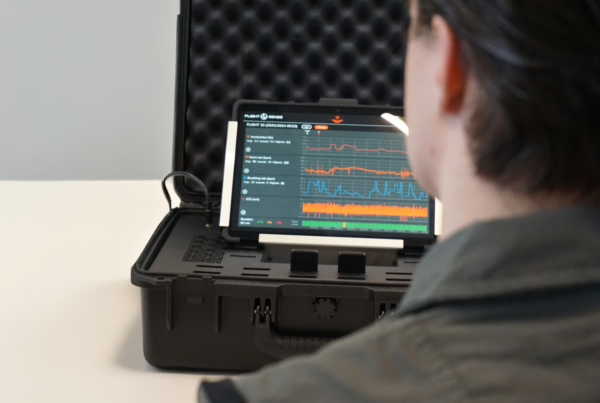
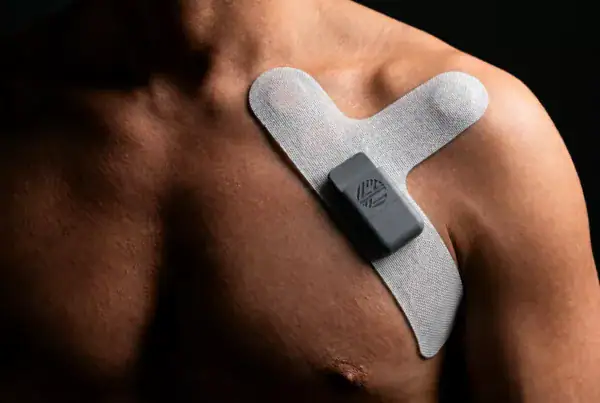
Wearables that capture biosignals — ECG, EMG, EDA, or movement via IMU — face a specific challenge: the body moves, and motion introduces artefacts that corrupt the signal. Dry electrode selection, electrode placement, and motion artefact compensation in firmware are all active engineering problems. Getting a clean biosignal from a moving person in a real environment is considerably harder than capturing the same signal from a seated patient in a clinical setting.
How do you ensure comfort and wearability in device design?
Ensuring comfort and wearability requires integrating human factors into the design process from the earliest stage, not retrofitting ergonomics once the electronics are fixed. Comfort is determined by weight distribution, pressure points, material breathability, and how the device responds to the wearer’s movement. These factors must be tested on real users in realistic conditions — not assumed from a CAD model.
The most common mistake in wearable product development is treating the electronic design as the primary challenge and wearability as a finishing step. In practice, a device that users refuse to wear — because it chafes, overheats, or shifts position during activity — has failed regardless of its technical specification.
Effective wearability design involves several parallel workstreams:
- Material selection: Fabrics must balance conductivity, stretch, washability, and skin compatibility. There is rarely a single material that optimises all of these, so the team must make informed trade-offs based on the use case.
- Weight and form factor: Electronics should be distributed across the garment where possible, rather than concentrated in a single module that creates a pressure point or shifts the centre of gravity.
- Iterative user testing: Comfort cannot be evaluated in a lab by engineers alone. Structured user testing across representative body types and activity levels is essential, and feedback must loop directly back into design decisions.
- Interaction design: If the device involves haptic feedback, audio cues, or physical controls, the interaction must be intuitive without requiring the wearer to look at or consciously manage the device during use.
Haptic feedback presents its own comfort challenge. Vibration actuators that feel informative at one intensity can become irritating or distracting at another. Firmware-level timing and pattern design — not just actuator selection — determines whether haptic output enhances the user experience or degrades it.
What regulatory and certification hurdles do wearable products face?
Wearable products face regulatory requirements that vary significantly by sector and intended use. Medical wearables must comply with the EU Medical Device Regulation (MDR), which imposes rigorous documentation, clinical evidence, and quality management requirements. Industrial wearables used in hazardous environments may require ATEX certification. Defence products carry their own procurement and certification standards. CE marking applies across most categories sold in Europe.
The challenge is not simply knowing which regulations apply — it is building the product in a way that satisfies them without making the device impractical or prohibitively expensive to manufacture. MDR compliance for a Class II medical device, for example, substantially increases both development time and cost due to the documentation burden, clinical evaluation requirements, and conformity assessment process. Teams that do not account for this from the outset typically face expensive redesigns late in the development cycle.
Several factors make regulatory navigation particularly difficult in biometric wearable product development:
- The classification of a device can shift based on how its output is described — a device that monitors heart rate for wellness is treated differently from one that monitors it for clinical decision support.
- Certification requirements interact with design decisions. ATEX certification for hazardous environments, for instance, constrains the choice of components, enclosure materials, and power systems in ways that must be factored into the hardware design, not added afterwards.
- Military certification requirements are project-specific and often involve additional environmental and durability testing that standard commercial wearables are not designed to withstand.
The safest approach is to identify the target certification pathway before finalising the product architecture, and to work with a development team that has navigated the relevant regulatory process before.
How does scaling from prototype to production affect wearable development?
Scaling from prototype to production is one of the most disruptive transitions in wearable product development. A prototype built with off-the-shelf components, hand-assembled in a lab, and tested by a small group of users will almost always require significant redesign before it can be manufactured reliably at scale. The gap between a working prototype and a manufacturable product is frequently underestimated.
Several specific issues emerge at this transition:
- Component availability: Parts selected for a prototype may not be available in production volumes, may be approaching end-of-life, or may be subject to supply chain constraints. Identifying and resolving component obsolescence before scaling avoids costly mid-production redesigns.
- Manufacturing tolerances: Hand assembly can compensate for small inconsistencies that automated manufacturing cannot. Designs that work in a prototype run often require tolerance tightening, jig design, or process changes to achieve consistent quality at volume.
- Textile production: Garment manufacturing introduces variability that electronics manufacturing does not. Stitch density, seam placement, and fabric lot variation can all affect the performance of integrated electronics, particularly conductive elements.
- Testing and quality control: A production line requires defined test procedures and pass/fail criteria that a prototype phase rarely formalises. Developing these in parallel with the production design — rather than after the fact — prevents quality escapes.
The transition is also where IP and documentation gaps become critical. If the design was developed by multiple vendors with no single party holding the full technical record, the handover to a manufacturer becomes chaotic. A development partner that maintains complete documentation throughout the process — covering hardware, firmware, textile specifications, and assembly procedures — significantly reduces this risk.
When should you bring in a specialist wearable development partner?
You should bring in a specialist wearable development partner as early as the feasibility stage, particularly when the product involves any combination of electronics, textiles, biosensing, or haptics. The later a specialist is introduced, the more expensive it becomes to correct decisions made without their input. Architecture choices made in the first weeks of a project can constrain the entire development — and some of those constraints only become visible when you try to certify or manufacture the product.
There are four situations in which bringing in a specialist partner is not just advisable but necessary:
- Your organisation has no in-house wearable expertise and is starting from a concept or early brief.
- You have a prototype, but it is not reliable or consistent enough for real-world use or user testing.
- You are working with standard component suppliers or single-discipline contractors who cannot resolve the cross-disciplinary challenges your project requires.
- Your project is stuck at the transition to production, with a prototype that cannot be manufactured at the required quality or cost.
In each of these situations, the cost of not bringing in a specialist is typically higher than the cost of the engagement itself. Redesigns, failed certification attempts, and delayed market entry are all substantially more expensive than early expert involvement.
The right partner is not simply a contractor who can execute a brief. They should be able to identify risks you have not yet seen, recommend the right technology for your specific use case, and hold accountability for the full system — not just the component they were hired to deliver.
How Elitac Wearables helps with wearable product development
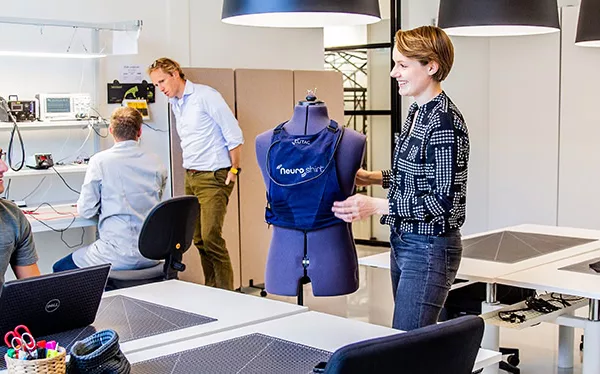
Elitac Wearables is a Netherlands-based wearable technology development partner that takes projects from initial concept through to certified, market-ready products. For B2B organisations in the medical, safety, and sports sectors, the value is straightforward: every discipline required to build a reliable wearable — hardware, firmware, textile integration, biosignal processing, haptics, human factors, and certification guidance — sits under one roof, with no handoffs between vendors and no knowledge gaps at the boundaries.
For decision-makers evaluating a development partner, the practical implications are:
- Faster iteration: The in-house 180m² Wearables Lab, equipped with 3D printers, laser cutters, and permanent software testing setups, means prototypes are built and tested without waiting on external suppliers.
- Reduced technical risk: The proprietary TacOS firmware platform, built specifically for wearables, accelerates embedded development and reduces the risk of firmware-level failures that are expensive to diagnose late in the cycle.
- Regulatory readiness: The team has direct experience with MDR, CE, ATEX, and military certification requirements, and factors compliance into the architecture from the start — not as an afterthought.
- Production continuity: Elitac Wearables coordinates the transition to manufacturing through a trusted network of partners, maintaining the technical documentation and quality standards required for consistent production.
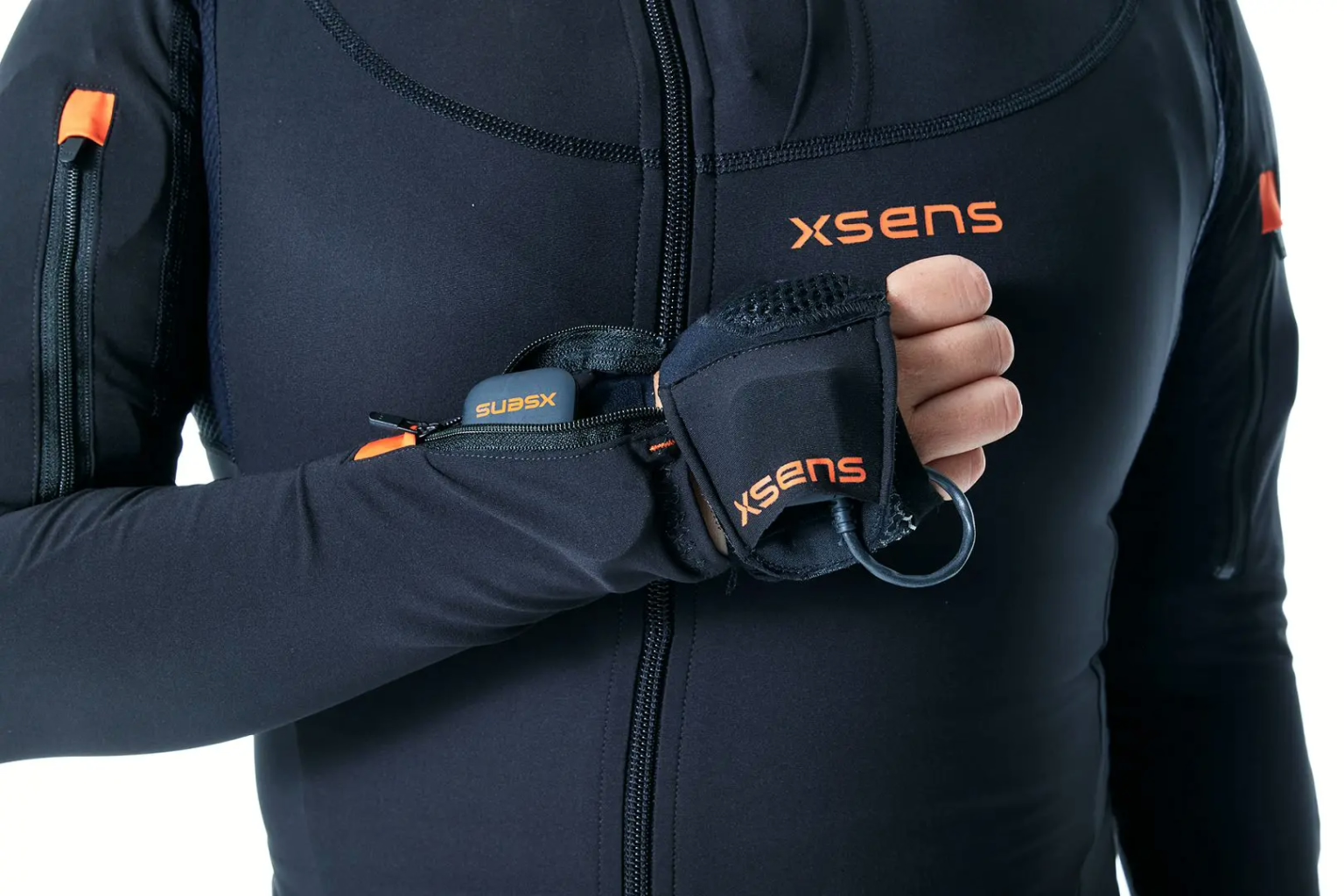
- Proven outcomes: Reference projects include the Mission Navigation Belt for the Royal Netherlands Army, biosensor wearables for clinical and sports applications, and motion capture suit contributions for Xsens — across more than 50 products developed over a decade.
If your wearable development project has hit a wall — whether at concept, prototype, or the transition to production — contact Elitac Wearables to discuss where your project stands and what the right next step looks like.
Related Articles
- What industries benefit most from smart textile development?
- What data do military wearables collect during operations?
- What happens to haptic feedback wearables after long-term daily use?
- Can haptic feedback wearables help people with hearing impairments?
- How do you protect your IP during wearable product development?