Integrating electronics into textiles means embedding sensors, actuators, conductive pathways, and processing components directly into fabric structures, creating garments that can monitor, respond to, or communicate with the body. The result is a wearable that is not a device worn on top of clothing but part of the clothing itself. This distinction has significant consequences for comfort, accuracy, and real-world usability, and the sections below unpack exactly what that means across health, industry, design, and development.
How does integrating electronics into textiles actually work?
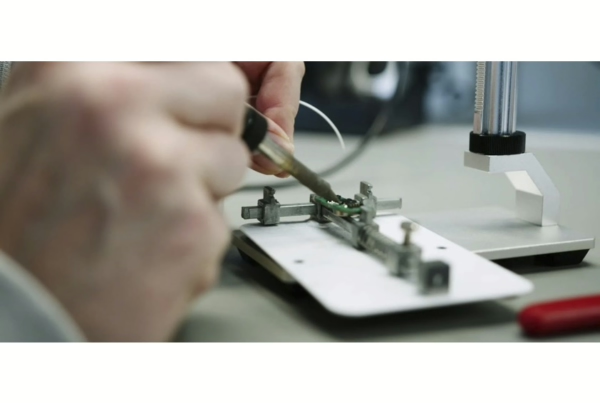
Electronics are integrated into textiles by embedding conductive materials, sensors, and actuators into fabric using techniques such as conductive yarn weaving, embroidery, lamination, overmolding, and printed electronics on flexible substrates. The electronics become part of the garment’s structure rather than attachments to it, allowing the fabric to flex, stretch, and breathe while still carrying electrical signals.
The specific integration method chosen depends heavily on the product’s requirements. Conductive yarns woven or knitted directly into a base fabric work well for biosignal sensing applications where skin contact is essential, such as ECG or EMG monitoring. Printed conductive inks on flexible substrates suit rigid-to-flexible transitions, while overmolding protects electronic components at connection points where mechanical stress is highest.
One of the most underestimated challenges in smart textile development is that the electronics must behave correctly on a moving body. A sensor that performs reliably on a bench behaves very differently when the fabric stretches, the user sweats, or the garment shifts during activity. This is why integration technique selection is inseparable from the garment’s use case, the body location, and the movement profile of the wearer.
Connection points between rigid electronics and flexible textile structures are a frequent failure zone. Managing these transitions, ensuring washability, maintaining signal integrity under repeated mechanical stress, and selecting biocompatible materials are the disciplines that separate a functional prototype from a product that survives real-world use. This is a completely different engineering domain from standard electronics development, and it requires textile expertise alongside hardware and firmware knowledge.
What health and medical advantages do e-textiles offer?
E-textiles offer significant health and medical advantages because they enable continuous, unobtrusive monitoring of physiological signals directly at the skin surface, without requiring the wearer to attach separate devices. This improves data quality, increases patient compliance, and makes long-term monitoring practical in everyday environments rather than only in clinical settings.
Dry-electrode e-textiles, for example, can measure ECG, heart rate, heart rate variability, respiration, and muscle activity throughout a normal day. Because the electrodes are built into the garment, the wearer does not need to apply gel, attach adhesive patches, or think about the monitoring process at all. For chronic condition management, rehabilitation, and preventive health monitoring, this passive data collection is a meaningful clinical advantage.
Haptic feedback for rehabilitation and balance
Beyond sensing, e-textiles can deliver therapeutic feedback directly through the body. Haptic actuators embedded in a garment can provide real-time postural cues, balance assistance, or motor rehabilitation prompts without requiring the patient to look at a screen or listen to an audio signal. Elitac’s BalanceBelt is a working example: a medical wearable that combines motion sensing with haptic feedback to help people with severe balance disorders walk confidently, restoring independence in a lightweight, discreet form factor.
Improved biosignal accuracy through closer skin contact
Textile-integrated sensors maintain more consistent skin contact than chest-strap or clip-on devices, which reduces motion artifacts and improves signal quality. In applications where signal accuracy is clinically relevant, such as cardiac monitoring or stress assessment via heart rate variability, this contact consistency translates directly into more reliable data and fewer false readings that would otherwise require clinical review.
How do smart textiles improve comfort compared to traditional wearables?
Smart textiles improve comfort by distributing electronics across a garment rather than concentrating them in a rigid enclosure, eliminating the pressure points, restricted movement, and heat buildup associated with traditional wrist-worn or chest-mounted devices. Because the garment itself is the wearable, users experience it as clothing rather than as equipment.
Traditional wearables solve the form factor problem by making the device as small as possible. Smart textiles solve it differently: by removing the hard enclosure almost entirely and spreading the functional elements across a surface the body already accepts. This approach is particularly valuable for applications requiring all-day or overnight wear, where even a small rigid device becomes uncomfortable over time.
Weight distribution is another practical advantage. A garment with integrated sensors spreads mass across the torso, arm, or leg rather than loading it onto a single point like a wrist or ankle. For users who need to wear a monitoring device during physical work, sport, or sleep, this difference in how the load is felt is significant.
Comfort also depends on textile selection. The right base fabric, seam construction, and finishing determine whether a smart garment is genuinely wearable for extended periods. This is why textile engineering is not a secondary consideration in e-textile development but a core discipline that must be integrated from the earliest design phase, not added at the end.
What industries benefit most from textile-integrated electronics?
The industries that benefit most from electronics integrated into textiles are medical and health monitoring, defense and military, sports performance, and industrial safety, because these sectors share a common requirement: reliable, body-worn data collection or feedback delivery in environments where a conventional handheld or screen-based device is impractical or unsafe.
Medical and health monitoring
In medical applications, e-textiles enable remote patient monitoring, post-operative rehabilitation tracking, and chronic disease management without requiring patients to change their daily routines significantly. Garments that monitor cardiac rhythms, respiratory patterns, or movement quality provide clinicians with richer longitudinal data than periodic clinic visits can produce.
Defense and military
Defense applications place extreme demands on wearable technology. The Mission Navigation Belt developed for the Royal Netherlands Army demonstrates what textile-integrated haptics can achieve: silent, screen-free navigation delivered through the body, keeping soldiers’ hands, eyes, and ears available for their primary tasks. Ruggedization, reliability under physical stress, and integration with existing equipment are the defining requirements in this sector.
Sports performance and coaching
In sports, e-textiles allow biomechanical data to be captured during actual training and competition rather than in controlled laboratory conditions. Pressure sensors, inertial measurement units, and muscle activity monitors embedded in garments provide coaches and athletes with movement data that reflects real performance, not a simulation of it.
Industrial safety and workwear
For workers in physically demanding or hazardous environments, smart workwear can monitor fatigue, posture, vital signs, or environmental exposure without adding equipment that interferes with the job. The value here is in passive monitoring that does not demand any action from the wearer.
What are the current limitations of electronics in textiles?
The primary limitations of electronics integrated into textiles are washability and durability over repeated laundering cycles, power supply constraints, the mechanical fragility of connections between rigid electronics and flexible fabric, and the complexity of achieving regulatory compliance for medical or safety applications. None of these are unsolvable, but each requires deliberate engineering from the start.
Washability is often the first limitation teams encounter. Conductive yarns, flexible circuits, and electronic components must all survive repeated exposure to water, detergent, and mechanical agitation. Encapsulation and overmolding techniques can protect components at connection points, but the solution must be designed in from the beginning, not retrofitted after the garment is otherwise complete.
Battery life and power management present a second category of constraints. Textile-integrated systems typically cannot accommodate large battery packs, which means power efficiency must be optimized at every level: hardware selection, firmware architecture, data transmission protocols, and sensor duty cycles. Teams that treat battery size as the solution to battery life problems almost always discover too late that the real problem is system-level inefficiency.
Signal integrity under movement is a further challenge. Conductive pathways in fabric stretch, compress, and flex with every movement the wearer makes. Maintaining consistent electrical performance across that range of motion requires careful routing design, appropriate material selection, and thorough validation under realistic movement conditions, not just bench testing.
Finally, regulatory requirements for medical e-textiles are substantial. MDR compliance in Europe demands that design decisions made early in development, including material choices, integration techniques, and sterilization compatibility, are documented and validated in ways that support a clinical evidence dossier. Teams that treat certification as a final-phase activity routinely discover that earlier design choices are incompatible with the regulatory pathway they need.
When should a product use e-textiles instead of a standard wearable device?
A product should use e-textiles instead of a standard wearable device when continuous skin contact is required for signal quality, when comfort over extended wear periods is a primary requirement, when the use environment makes a rigid device impractical, or when the product must be invisible or unobtrusive to the user. If none of these conditions apply, a conventional wearable form factor is likely simpler and more cost-effective to develop.
The decision is rarely purely technical. It involves the target user’s acceptance of the product, the clinical or operational context in which it will be used, and the development budget and timeline available. E-textile development carries higher integration complexity and longer validation cycles than standard wearable development, and that cost is only justified when the textile form factor delivers a genuine functional or user experience advantage.
A useful test is to ask what fails if the product is built as a conventional device. If the answer is signal quality, comfort, user compliance, or operational practicality, then e-textile integration is likely the right direction. If the answer is primarily aesthetic preference, the added complexity may not be warranted.
It is also worth considering where the product sits in its development lifecycle. Early-stage concepts benefit from conventional prototyping approaches before committing to textile integration, because the integration adds cost and time to every iteration. Validating the core functionality with off-the-shelf components first, then transitioning to textile integration once the working principle is confirmed, is a more efficient path for most development programs.
How Elitac Wearables helps with electronics integrated into textiles
Elitac Wearables specializes in exactly the problem this article describes: building wearables where the electronics and the textile are not two separate problems handed to two separate teams, but a single engineering challenge solved under one roof. For organizations that need a development partner rather than a component supplier, Elitac brings every relevant discipline together, including hardware, firmware, textile engineering, biosignal processing, haptics, and certification guidance.
- Full end-to-end development from feasibility check through to certified, production-ready product
- In-house 180m² Wearables Lab with 3D printers, laser cutters, and permanent software testing setups for faster iteration
- Proprietary TacOS firmware platform that reduces development time and cost for wearable-specific applications
- Deep experience with dry-electrode biosensing, haptic actuator integration, and textile-compatible electronics across medical, defense, and sports sectors
- MDR compliance guidance built into the development process from phase one, not added at the end
- A “build for validation” approach that delivers functional demonstrators before major tooling investment, reducing financial risk
If your organization is working on a product where standard solutions fall short, speak to the Elitac team about your development challenge. The earlier the conversation happens, the more options remain open.
Related Articles
- How do wearables help treat battlefield injuries faster?
- Can haptic feedback wearables be customized for specific workflows?
- How do haptic wearables differ from force feedback devices?
- What is the role of AI in modern wearable product development?
- How do you choose the right hardware for a wearable device?