

You plan a wearable development partnership beyond the first prototype by mapping every remaining phase (validation, pilot samples, final prototype, certification, first series, scaled production) before the first one ends, then agreeing on scope, IP, and handover rules for each. The prototype proves a principle. The partnership has to prove a product. Planning for that gap early is what separates wearables that ship from the ones that stall. The sections below answer the questions teams ask most when they move from a working demonstrator toward market.
What typically breaks between a working prototype and a product?
Reliability, power, certification, and manufacturability typically break between a working prototype and a product. A demonstrator built on off-the-shelf parts and wired connections shows that a principle works, but it rarely survives daily wear, washing, regulation, or repeatable assembly.
The most common failure points follow a pattern:
- Battery and power management: a bench supply or oversized cell hides problems that surface once the device must run all day in a slim, comfortable housing.
- Wireless behaviour on the body: connectivity that works on a desk degrades when the body absorbs and reflects the signal.
- Textile integration: conductivity, washability, biocompatibility, and sizing only become real constraints once electronics sit inside a garment.
- Motion artefacts: biosensors that read cleanly at rest produce noisy data when the wearer moves.
- Assembly repeatability: a part that one engineer builds by hand in a lab is not a part a production line can build 1,000 times.
Industry experience suggests that most wearable prototypes never reach production, and the main cause is validating too late rather than technical infeasibility. Teams discover the battery, comfort, or certification problem after they have already committed to tooling, which typically costs between 100K and 500K euros. Building for validation first, then for production, keeps those discoveries cheap.
Which development phases should a partnership plan cover?
A wearable development partnership should plan all six phases up front: feasibility check, proof of concept, pilot samples, final prototype, first series, and scaled production. You do not need to commit budget to all six at once, but you need a shared view of what each phase delivers and what decision closes it.
- Feasibility check: a desktop assessment of whether the idea is theoretically possible, ending in a Go/No-Go decision. Indicative cost runs from 1K to 10K euros, over roughly two weeks.
- Proof of concept: a rudimentary demonstrator that shows the working principle functions as intended. Indicative cost runs from 5K to 20K euros.
- Pilot samples: wearable samples for user testing, comfort, and early validation. Indicative cost runs from 15K to 30K euros.
- Final prototype: the engineered version, with certification-relevant design decisions locked in. Indicative cost runs from 40K to 100K euros.
- First series: a limited production run that proves the build process. Indicative cost runs from 20K to 70K euros.
- Scaled production: repeatable manufacturing at volume. Indicative cost also runs from 20K to 70K euros.
These figures are rough estimates and depend heavily on the type of wearable and its complexity. The practical point is that phases one to three de-risk the concept quickly and cheaply, while phases four to six build and manufacture the validated product. Define the exit criteria for each phase in writing, so the next budget release is a decision rather than a negotiation.
How should scope, IP and ownership be structured?
Structure scope phase by phase, with a defined deliverable and acceptance criteria for each, and agree on IP ownership before development starts. The cleanest arrangement separates what the client owns (the product concept, final design, and application-specific work) from what the development partner retains (reusable building blocks, firmware platforms, and integration techniques).
Three points deserve explicit written agreement:
- Foreground and background IP: background IP is what each party brings to the project, such as a partner’s firmware platform or a client’s existing algorithms. Foreground IP is what the project creates. Name both categories in the contract and state who owns what and what licence applies to the rest.
- Documentation handover: specify which files transfer at each phase, including schematics, bill of materials, firmware source, CAD, and test reports. Without these, switching manufacturers later becomes costly or impossible.
- Change control: wearables evolve as user tests reveal new requirements. Agree on how scope changes are priced and approved so that iteration does not turn into a dispute.
Scope the next phase only when the previous one is complete. Fixed-scope phases with clear deliverables protect both sides, and they keep budget exposure low while the product remains uncertain.
Should prototyping and production stay with one partner?
Prototyping and early production should usually stay with one partner, because the team that built the prototype understands its design constraints, test setups, and failure modes. Larger-scale manufacturing often moves to a dedicated production partner, but that transition should be planned from the start rather than improvised at handover.
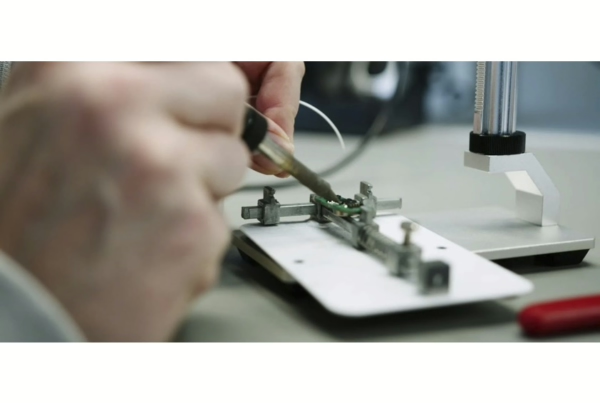
Keeping one partner through the first series has clear advantages. There is no knowledge loss at the handover between design and build, firmware and hardware stay aligned, and fixes found during a limited run feed straight back into the design. A partner with its own lab can also run limited production directly. A 180m² facility with 3D printers, laser cutters, and permanent software test set-ups, for example, can handle everything from prototyping to limited production of up to 100 pieces.
Volume changes the calculation. At larger quantities, a specialised manufacturing partner with the right capacity and quality systems makes more sense. The decision factors are production volume, certification requirements, and who owns the process documentation. Ask any prospective partner how they manage the transition to volume manufacturing and which manufacturing partners they already work with. A credible answer names a network of vetted manufacturers and describes how they transfer design-for-manufacturing knowledge, rather than simply handing over files.
What should you look for in a wearable development partner?
Look for a partner with proven experience in your specific discipline, in-house capability across hardware, firmware, textiles, and algorithms, a documented development process, and a track record of products that reached the market. Evidence of shipped, certified products matters more than a polished portfolio of demonstrators.
Use these criteria when evaluating candidates:
- Specialisation depth: haptic wearable development and smart textile development are narrow fields with high technical barriers. A general electronics shop rarely has the actuator selection, textile integration, and timing design experience these require.
- In-house facilities: a partner with its own lab iterates faster and carries less handoff risk than one that outsources core steps.
- Regulatory experience: for medical products, ask about MDR compliance, quality management, and clinical validation. Wearable product certification should shape hardware choices early, not arrive as a surprise after the final prototype.
- Process transparency: a clear phase structure with defined deliverables, cost ranges, and Go/No-Go points signals a team that plans accurately.
- Research connections: ties to universities and research institutes keep a partner current on new materials and sensing techniques.
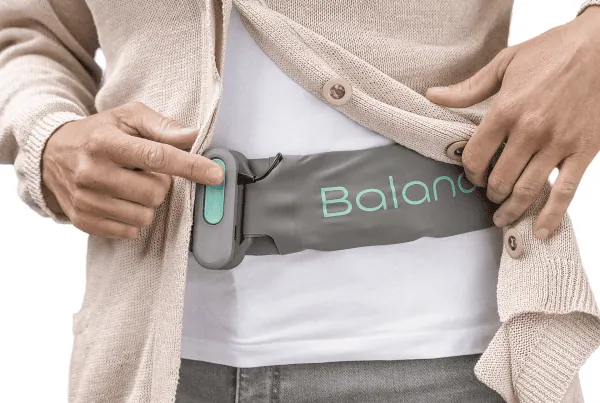
- Sector references: projects such as a commercially launched balance disorder wearable or a haptic navigation belt delivered to a national army demonstrate that a team has handled real regulatory and field conditions.
Also ask what happens when a project is stuck. Teams that arrive with a prototype that is not reliable enough, or a project stalled at the production transition, need a partner that diagnoses problems, not just one that builds to specification.
How can risk be managed as the partnership scales?
Manage risk by validating early, releasing budget in stages, and designing for manufacturing and certification before the final prototype. Each phase should retire a specific risk, so that by the time tooling and production commitments arrive, the major unknowns are already answered.
Validate before you commit to tooling
Use pilot samples to test comfort, user interaction, and perceived value with real users before locking designs. Tooling is the most expensive irreversible step, so evidence from wearers should come first. Test battery performance under realistic daily use during this stage, not at the end.
Design for manufacturing and certification early
Designing for manufacturing for wearables means choosing integration techniques, components, and assembly methods that a production line can repeat reliably. Raise it during the final prototype phase at the latest. For regulated products, consider certification requirements from the first architecture decisions, since late changes to hardware can force repeated testing and redesign.
Beyond design, keep a few governance habits in place. Hold regular reviews against the phase exit criteria, keep a risk register that both sides update, and maintain a clear Go/No-Go decision at each phase boundary. A No-Go after a 5K proof of concept is a success if it prevents a 100K final prototype on a flawed concept.
How Elitac Wearables helps with wearable development beyond the first prototype
Elitac Wearables takes wearable products from idea to certified, market-ready product with hardware, firmware, textile, and algorithm expertise under one roof. The structured six-phase process covers every step from feasibility to scaled production, so the gap between prototype and product does not become a handoff problem.
- Haptic specialists who select actuators and design the full haptic system, including firmware-level timing
- A 180m² in-house Wearables Lab for fast iteration and limited production of up to 100 pieces
- Proven medical, defence, and sports projects, including MDR-compliant development experience
- A reliable network of manufacturing partners for production at larger scale
- TacOS, a proprietary firmware platform that makes wearable development faster, cheaper, and more compact
Curious about the different ways to work with our team? Or have a prototype that is stuck on the road to production? Contact us and tell us where your project stands.
Related Articles
- What is the difference between an exoskeleton and a smart vest?
- What is the battery impact of haptic feedback on wearable devices?
- What is the future of haptic feedback wearable technology?
- How do haptic feedback wearables work for navigation?
- What is the cost of developing a wearable product from scratch?