Electronics integrated into textiles means embedding functional electronic components, sensors, actuators, conductive pathways, or microcontrollers, directly into fabric so the garment itself becomes the device. Rather than attaching a rigid module to clothing, the electronics become part of the textile structure, enabling wearables that are flexible, comfortable, and unobtrusive. The sections below unpack how this works in practice, where it is used, and when it is actually the right engineering choice.
How are electronics physically embedded into fabric?
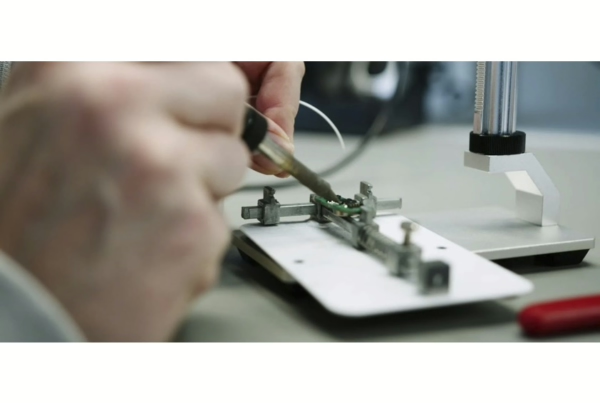
Electronics are embedded into fabric through several distinct integration techniques, each suited to different functional requirements and product contexts. The most common approaches include conductive yarns woven or knitted directly into the fabric structure, printed conductive inks applied to textile surfaces, and rigid or flexible electronic modules attached via snap connectors, adhesive bonding, or overmoulding. The right technique depends on the required flexibility, washability, and durability of the final product.
Conductive yarns, typically silver-coated or stainless steel threads, can carry electrical signals between components without any visible wiring. These yarns are integrated during the fabric manufacturing process itself, making them highly durable and compatible with standard garment construction. For more complex circuits, conductive inks are screen-printed or inkjet-printed onto fabric surfaces, allowing fine traces and electrode patterns to be applied with precision.
Where rigid components are unavoidable, microcontrollers, batteries, or radio modules, engineers use encapsulation techniques such as overmoulding, which encases the component in a flexible polymer that protects it while allowing the surrounding fabric to remain pliable. Snap connectors and textile-friendly PCB attachment methods allow modular components to be removed before washing and reattached afterwards, which is a practical solution for many medical and workwear applications.
Each technique involves real trade-offs. Conductive yarns offer excellent washability but have higher resistance than copper traces. Printed conductors enable fine patterning but can degrade with repeated flexing. Overmoulded modules add bulk. Selecting the right integration method requires understanding the full use environment, not just the electronics, but the body mechanics, sweat exposure, laundering cycles, and regulatory requirements the product will face.
What types of electronic components can be integrated into textiles?
A wide range of electronic components can be integrated into textiles, including sensors, actuators, microcontrollers, antennas, power sources, and communication modules. The key constraint is not the component category but the form factor: components must either be inherently flexible, small enough to encapsulate without compromising wearability, or designed to be detachable from the textile carrier.
Sensors
Textile-integrated sensors are among the most mature applications in smart textile development. Electrodes woven from conductive yarn can measure biosignals such as ECG and EMG directly from the skin. Pressure-sensitive fabrics detect force distribution across surfaces. IMUs (inertial measurement units) embedded in small enclosures track movement, orientation, and acceleration. Temperature sensors monitor skin or ambient conditions. The challenge with body-worn sensors is motion artefact: signals distort when the fabric moves relative to the skin, which requires both good electrode design and intelligent signal processing to address.
Actuators and feedback components
Haptic actuators, vibration motors, linear resonant actuators, and piezoelectric elements, can be distributed across a garment to deliver tactile feedback to the wearer. This is the core technology behind products like the Mission Navigation Belt, which delivers directional guidance to soldiers through vibration patterns rather than visual or audio cues. Heating elements using resistive conductive yarns are another actuator category, used in heated workwear and therapeutic garments. LEDs and electroluminescent elements can also be integrated, though these are more common in performance and safety-visibility applications than in medical or defence contexts.
What is the difference between e-textiles and regular wearable technology?
The fundamental difference between e-textiles and regular wearable technology is where the electronics live. In conventional wearables, a rigid electronic device, a watch, a chest strap, a clip-on sensor, is worn on or attached to the body. In e-textiles, the electronics are embedded within the fabric itself, so the garment is the device. This distinction has significant consequences for comfort, form factor, and the complexity of development.
A fitness tracker worn on the wrist is a wearable, but it is essentially a miniaturised consumer device with a strap. An e-textile ECG shirt, by contrast, has conductive electrodes knitted directly into the fabric, signal processing embedded in a small detachable module, and no rigid housing pressing against the body. The experience for the wearer is fundamentally different: the garment feels like clothing because it is clothing.
From an engineering perspective, this distinction matters enormously. Designing electronics for a rigid enclosure follows well-established rules. Designing electronics that must survive stretching, washing, sweat, and continuous body movement requires a completely different discipline. Flexible circuits behave differently from rigid PCBs. Textile substrates introduce variability that does not exist in conventional electronics manufacturing. This is why organisations that are highly capable at building conventional medical devices or industrial electronics often find that the wearable layer requires specialist expertise they do not have in-house.
What industries use electronics integrated into textiles?
Electronics integrated into textiles are used across medical, defence, sports performance, and industrial safety sectors. Each industry applies the technology differently based on its specific requirements for data collection, user feedback, or environmental monitoring, but all share the same underlying need: to gather information from or deliver information to a moving human body without restricting natural movement.
In medical applications, e-textiles enable continuous, unobtrusive monitoring of patients outside clinical settings. Garments with integrated ECG electrodes, respiration sensors, or motion tracking allow clinicians to collect longitudinal data that would be impossible to gather in a hospital environment. The BalanceBelt, developed by Elitac Wearables, is a commercially launched example: a medical wearable that combines motion sensing with haptic feedback to help people with severe balance disorders walk independently.
In defence and public safety, e-textiles serve a different purpose: delivering information to the wearer without requiring them to look at a screen or listen to an audio signal. The Mission Navigation Belt developed for the Royal Netherlands Army uses haptic feedback delivered through a textile-integrated belt to provide silent, hands-free navigation guidance to soldiers in the field. This keeps hands, eyes, and ears available for the mission.
In sports and performance, smart textiles monitor biomechanical data, pressure distribution, joint angles, muscle activation, to support coaching, injury prevention, and performance optimisation. In industrial and workwear contexts, integrated sensors detect environmental hazards, monitor worker fatigue, or track compliance with safety protocols in environments where carrying a handheld device is impractical.
What are the main technical challenges of developing e-textiles?
The main technical challenges of e-textile development are durability under repeated mechanical stress, signal integrity on a moving body, power management within a flexible form factor, washability of integrated components, and the complexity of combining electronics and textile manufacturing disciplines that rarely overlap. Each of these challenges compounds the others, which is why e-textile development fails more often than conventional electronics projects.
Durability and washability are perhaps the most practically demanding issues. Conductive yarns fatigue and break with repeated flexing. Printed conductors delaminate. Connections between rigid components and flexible substrates are points of mechanical failure. Any product intended for real-world use must survive hundreds of wash cycles, continuous body movement, and exposure to sweat and humidity, conditions that standard electronics are never designed to withstand.
Signal integrity is a persistent challenge for sensing applications. Electrodes that sit against moving skin pick up noise from muscle movement, fabric displacement, and variable contact pressure. Filtering this noise without discarding genuine biosignal data requires both careful electrode placement and sophisticated signal processing algorithms, a combination of hardware and software expertise that few teams hold simultaneously.
Power management in a flexible, distributed system is genuinely difficult. Batteries must be small and lightweight enough not to compromise wearability, but the power demands of continuous sensing, wireless transmission, and actuation are real. Increasing battery size is rarely the right answer: it triggers a cascade of redesign consequences. The better approach is system-level optimisation across hardware, firmware, and data architecture to extract maximum life from the smallest possible power source.
Finally, there is the challenge of fragmented expertise. Electronics engineers and textile specialists rarely work in the same organisation, speak the same language, or share the same development tools. When these disciplines are split across separate suppliers, no single party owns the integration, and that is where most e-textile projects stall or fail.
When does a product actually need electronics integrated into the textile itself?
A product genuinely needs electronics integrated into the textile when the use case requires continuous body contact, distributed sensing or actuation across a surface area, or a form factor that a rigid attached device cannot achieve. If a clip-on module or wristband can deliver the same outcome, it almost certainly should: it will be cheaper and faster to develop. E-textile integration earns its complexity when wearability, coverage, or unobtrusiveness are non-negotiable requirements.
Consider the difference between measuring a single ECG lead and measuring full-body muscle activation across a motion capture suit. A chest strap with two electrodes can capture a basic ECG signal. But mapping the electrical activity of multiple muscle groups simultaneously, across a moving body, requires electrodes distributed across a garment, which means the textile has to carry both the sensing surfaces and the signal pathways. There is no practical alternative.
Similarly, haptic feedback delivered to multiple body locations simultaneously, as in navigation belts or balance rehabilitation devices, requires actuators positioned precisely across a surface that conforms to the body. A rigid device attached at one point cannot replicate this. The distribution of feedback across the body surface is the function, and only textile integration can deliver it.
The honest question to ask early in any development project is: does the user experience require the electronics to be in the fabric, or does it just feel like a more elegant solution? Elegance is not a sufficient reason to take on the additional complexity, cost, and certification burden of e-textile integration. But when coverage, comfort, or distributed function genuinely demand it, textile integration is not a design preference: it is an engineering requirement.
How Elitac Wearables helps with electronics integrated into textiles
Elitac Wearables is a Netherlands-based development partner that specialises in exactly the intersection where most projects stall: the point where electronics and textiles have to work together as one system. For organisations that have deep domain expertise but have not yet built the wearable layer, Elitac provides the missing capability without requiring clients to build an entirely new team.
- Full end-to-end development from feasibility check through to certified, production-ready product
- In-house expertise across hardware, firmware, textile engineering, biosignal processing, and haptics, all under one roof
- A 180m² Wearables Lab with 3D printers, laser cutters, and permanent software testing set-ups for faster iteration
- Proven delivery across medical, defence, and sports sectors, including the BalanceBelt and Mission Navigation Belt
- Proprietary TacOS firmware platform for faster, more cost-efficient wearable development
- Guidance on regulatory compliance and certification from the earliest stages of development
If you are working on a wearable concept that requires electronics integrated into textiles and need a development partner who has solved these problems before, speak with the Elitac team to discuss your project.
Related Articles
- Why is smart textile development so difficult to commercialize?
- What is the difference between an exoskeleton and a smart vest?
- What materials are used to make military wearables durable?
- How do developers integrate haptic feedback into wearable devices?
- What are the biggest challenges in wearable product development?